

Introduction
Over the past few years, Artificial Intelligence (AI) has been transforming the healthcare landscape from digital data to AI agents. These AI agents act like personalized digital assistants that go beyond storing information. They analyze data, interpret patterns, plan actions, and deliver meaningful insights and recommendations, supporting better and faster decision-making in healthcare.
In addition, these systems can continuously learn from historical data, improving their performance over time. However, despite their potential, adoption has been challenging; nearly 70–85% of GenAI deployments have failed due to factors such as poor data quality, governance challenges, and organizational issues. As a result, these models often struggle to consistently produce accurate outcomes, especially in complex, highly variable healthcare settings.
To train the AI systems properly, AI developers and healthcare researchers need data on rare and hard-to-observe medical cases. That’s where synthetic data in healthcare comes as a game-changer, simulating real-world data without privacy concerns. With generative AI, you can create synthetic datasets that simulate rare events or entirely new clinical scenarios. These data are used in healthcare and robotics training models that are faster, cheaper, and without legal baggage. Synthetic data allows AI systems to learn from safe, scalable, and privacy-preserving data environments, without relying on real patient records.
Why Synthetic Data in Healthcare Matters?
By the year 2030, it is expected that synthetic datasets will surpass real data in AI model training. Due to patient privacy concerns, access to their data has always been a bottleneck to healthcare innovations. Healthcare organizations have formal guidelines for data storage and security.
As a result, many organizations are turning to synthetic data to overcome these challenges and accelerate innovation. Real healthcare data is often difficult, time-consuming, and expensive to collect, which slows down AI development and contributes to healthcare AI lagging behind other industries.
Synthetic data helps address these issues by:
- Enabling compliance with strict privacy regulations
- Reducing dependency on limited real-world datasets
- Accelerating AI model development and experimentation
- Facilitating secure data collaboration within and across organizations
- Lowering the cost and time required for data collection
In this way, synthetic data is emerging as a key enabler for faster, safer, and more scalable healthcare AI development.
Accessing a real patient’s data is quite risky and expensive. Some healthcare research stops due to a lack of uncommon patient conditions. Synthetic data for medical research and innovation brings a ray of light and fills the gaps.
Benefits of Synthetic Data
Many benefits of synthetic data in healthcare are listed below:
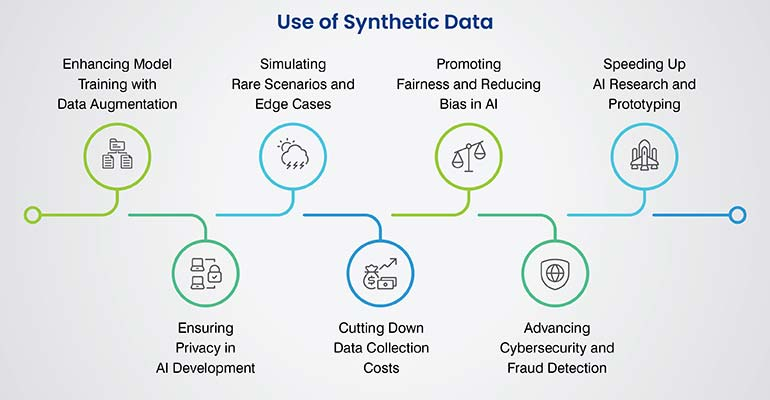
- Helps simulate rare disease cases
- Cut data-related costs by up to 70%
- Used in research, quality data is needed
- Produces new combinations & scenarios
- Training and validation of medical imaging models
- Testing the Accuracy and Efficacy of Medical Tools
- Augmenting Real-World Data for Enhanced Speed and Accuracy
- Synthetic data improves medical research
Market Trends of Synthetic Data in Healthcare
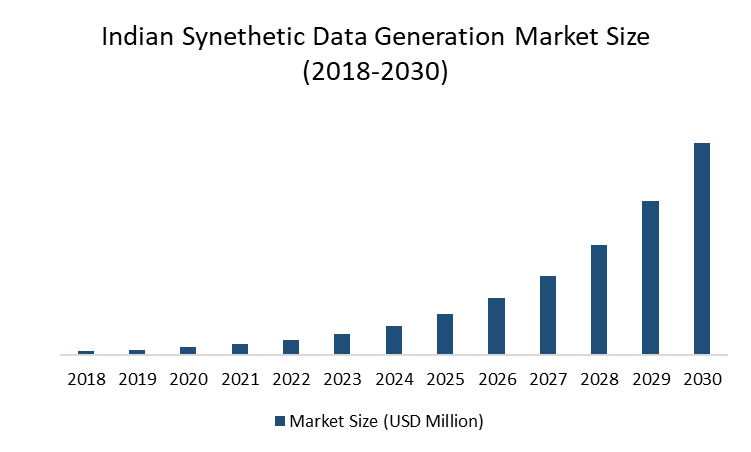
The Indian synthetic data generation market is expected to reach a projected revenue of USD 158.1 million by 2030. A compound annual growth rate of 39.2% is expected of India’s synthetic data generation market from 2024 to 2030.
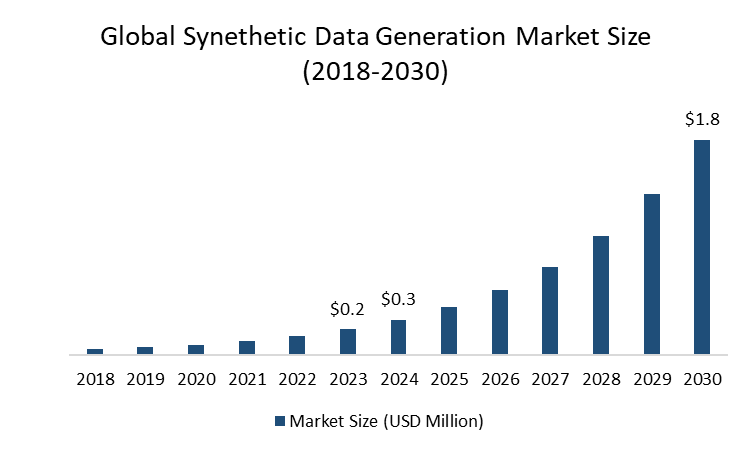
The global market trend of synthetic data generation was recorded at USD 218.4 million in 2023 and is predicted to reach USD 1,788.1 million in 2030 with a rate of 35.3% CAGR.
Synthetic Data vs Real Data
| Aspect | Synthetic Data | Real Data |
| Privacy Risk | Very low risk and easy to access | High risk of data breaches |
| Regulatory compliance | Easier to share | Strict |
| Cost | Low | High |
| Scalability | Unlimited | Limited |
| Accuracy | High but artificial risk | Real-world accurate |
| AI training | Excellent | Essential for validation |
Healthcare startups that are actively building synthetic data platforms
Creating artificial data with proper checks is a challenging task. Synthetic data can generate data for events that have never happened in the past. However, ensuring that this data accurately reflects real-world patterns requires careful design. It involves matching statistical distributions of real data, rigorously testing outputs with machine learning models, and maintaining strong documentation and governance. This is essential to ensure the synthetic data remains reliable, unbiased, and fit for downstream use.Indika AI
- Kroop AI
- Boltzmann
- AuraML
Real-World Use-Cases of Synthetic Data
Apart from healthcare, finance, retail, cybersecurity, and autonomous vehicles, these highly regulated industries are also using synthetic data most in India to overcome the challenges of data privacy, scarcity, and cost. Here are the real-world use cases of synthetic data in the healthcare and cybersecurity industries:
| Industry | Uses | Real-world use case |
| Healthcare | AI diagnostics training (radiology, pathology, EHRs) | Protects patient privacy while enabling large, diverse, and compliant datasets. |
| Clinical trial simulation and rare disease modeling | High cost, strict regulations, risk of data breaches | |
| Cybersecurity | Attack simulation and threat detection training | Creates realistic cyberattack scenarios without risking production systems. |
| Security system testing | Helps train models against new, unknown, and evolving attack patterns. |
Challenges & Limitations
Data quality concern: For creating replica patterns and generating artificial data, synthetic data heavily depends on the real-world data. Furthermore, the real-world data quality should be high because if the data is biased or incomplete, the synthetic data will reflect these shortcomings. Also, it may lead to fairness issues in AI models.
Lack of realism and accuracy: The biggest challenge and limitation of synthetic data is replicating patterns and generating realistic data that captures the nuances of real-world data. This raises a question of the lack of realism in accuracy.
Difficulty validating synthetic data: Another limitation is proving the accuracy of synthetic data. There is no guarantee that the synthetic data that is used to train a model will be accurate.
Limited diversity: Diversification is a necessity for training an AI model due to the lack of diverse data, which limits the ability of AI models to generalize and adapt to new or unseen scenarios, and reduces their effectiveness.
Ethical considerations: Uses of artificial data raise ethical concerns, particularly if it is used to simulate sensitive or personal data. This can include issues around privacy, consent, and data ownership.
Future potential
In the coming decade, the adoption of a hybrid approach will increase to train AI models. A hybrid approach is the combination of real data and synthetic data to achieve better performance, fairness, and resilience. Synthetic generative AI is one of the most powerful ways generative AI is transforming the healthcare industry. Reports show up 60% saving on training cost, plus improved model and accuracy on rare edge cases.
Data utility is maximized by eliminating constraints typically associated with exploring sensitive, patient-specific data. Because synthetic data are not specific to real patients, the Institutional Review Board (IRB) or ethics committee approval process is vastly streamlined, greatly reducing the time-to-insight. The government and industry bodies must develop a policy framework to guide the ethical and responsible use of synthetic data.
References:
https://www.cogentinfo.com/resources/synthetic-data-explosion-how-2026-reduces-data-costs-by-70
https://yourstory.com/2025/08/ai-startups-indika-onix-kroop-synthetic-data-platforms-solutions
https://www.shaip.com/blog/synthetic-data-and-ai
https://indiaai.gov.in/article/synthetic-data-description-benefits-and-implementation
https://www.tcs.com/what-we-do/industries/manufacturing/white-paper/synthetic-data-ai-revolution