

The Indian healthcare market has entered into a new era of surgical excellence powered by robotic surgery, and is growing rapidly. Things which were once considered a futuristic concept have now become a burgeoning trend. Earlier, the technology which was used only in premium hospitals is now also used in smaller hospitals as well. This transformation towards robotic-assisted surgery from conventional surgical procedures is driven by government initiatives, led by hospitals, med-tech startups, and world-class surgeons.
In 2023, the surgical market in India was valued at USD 851 million. Approximately 60,000 robotics-assisted procedures are being performed by 1500 surgeons each year in India. Now, let’s learn more about robotics surgery, its market, benefits, challenges, and future potential in India.
Why Robotic Surgery Matters
The robotic platforms are creating a new standard of care from urology and gynecology to cardiac, thoracic, gastrointestinal, and oncology surgeries. It enhances the surgeon’s experience by providing higher precision, better visualization, micro-instrument movement, AI guidance, real-time analytics, and more control in complex procedures. There are many benefits of these surgeries, such as:
- Precision and safety
- Smaller incisions
- Minimal blood loss
- Lesser pain after the operation
- Shorter hospital stays & faster recovery
- Lower risk of surgical complications
- Higher surgical accuracy in difficult anatomical regions
Market of Robotic Surgery in India
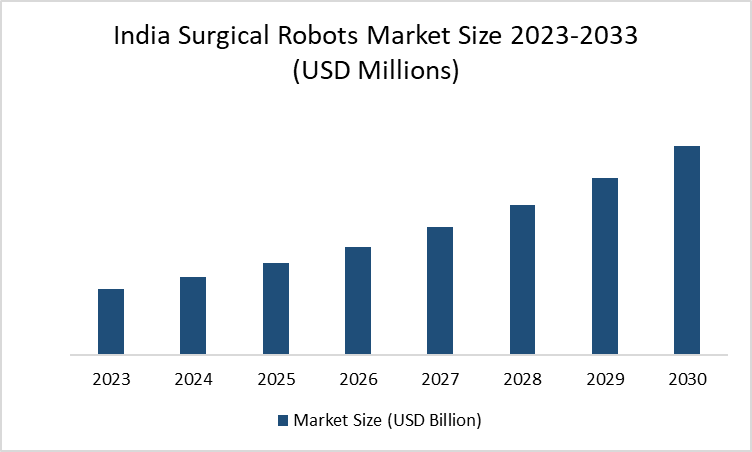
In terms of segments, including surgical robotic accessories, surgical robotic services, and surgical robots, the Indian market was valued at USD 450.6 million in 2024 and is expected to reach USD 1,212.3 million by 2030. It is predicted to grow with a CAGR of 17.4% from 2025 to 2030.
In 2024, the largest revenue-generating component was surgical robotic accessories, and the most lucrative component segment, registering the fastest growth during the forecast period, was surgical robotic services.
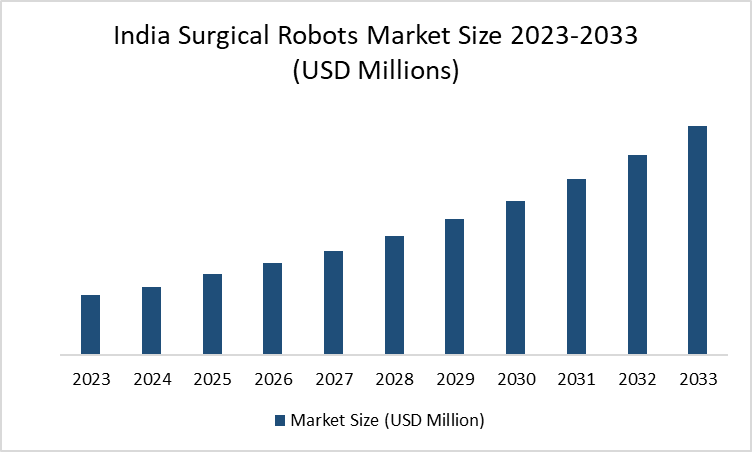
In terms of segments such as Urology, General Surgery, Gynecology, Orthopedics, Cardiothoracic, Neurosurgery, ENT (Otolaryngology), Bariatric / Metabolic, and other (vascular, pediatric, plastics), the Indian market was valued at USD 169.1 million in 2024 and expected to reach USD 569.0 million by 2033. It is predicted to grow with a CAGR of 14% from 2025 to 2033. In 2024, the largest revenue-generating application was urology, and the most lucrative application segment, registering the fastest growth during the forecast period, was orthopedics.
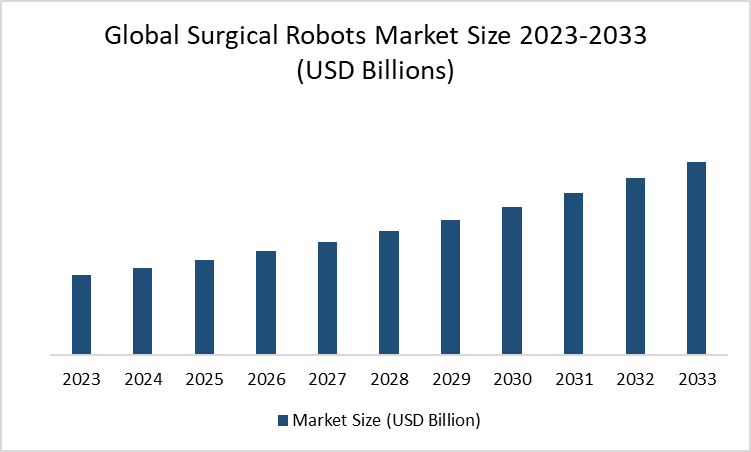
Global Surgical Robots Market Size
The global surgical robots market size was estimated at USD 4.31 billion in 2024 and projected to reach USD 9.60 billion by 2033, growing at a CAGR of 9.3% from 2025 to 2033.
The Rise of Robotic Surgery in India
Democratizing Access & Training
Recently, AIIMS, New Delhi, has inaugurated India’s first government medical college robot training facility. It provides robotic surgery training to various specialty surgeons, such as oncology, urology, general surgery, gynecology, etc.
Meril Life Sciences is an Indian company that has developed an indigenous surgical robot, Mizzo Endo 4000, aiming to lower cost barriers, make robotic surgery more accessible across socio-economic strata and geographies.
Reducing the gaps between urban and rural
In this new era, everything is possible for technology and innovation, and telesurgery proves it. Telesurgery technology, where a surgeon operates on a patient remotely using a robotic system, uses advanced connectivity technologies such as real-time visual data transmission, low-latency communication, and 5G fiber-optic networks. It will change the whole scenario and open the gates for patients in smaller cities who have limited access to specialized care.
Technological Innovation & Self-Reliance
Meril Life Sciences has developed the Mizzo Endo 4000, an advanced surgical robot featuring AI-driven 3D anatomical mapping, flexible soft-tissue handling, and 5G-enabled telesurgery. The growing demand for indigenous surgical robots like these is reducing India’s dependence on costly imports and fragile global supply chains.
At the same time, innovations in robotics and AI are increasingly complementing human surgical expertise. Together, they are improving procedural accuracy, enhancing patient outcomes, and reshaping the future of precision medicine in India.
Laparoscopic Surgery Vs Robotic Surgery
| Laparoscopic surgery | Robotic surgery |
| A surgeon uses long, handheld instruments. | A surgeon controls robotic arms from a console. |
| A 2D camera shows the surgical site on a screen. | A 3D high-definition camera provides deep, magnified visualization. |
| Movements are manual and somewhat restricted. | Robotic instruments have a greater range of motion |
| Limited instrument flexibility | 360° rotational movement |
| Learning curve is steep, especially for complex surgeries | Better precision in deep, narrow, or complex areas of the body |
| Less blood loss, faster recovery, lower risk of complications | Very minimal blood loss, fastest recovery, lowest risk of complication |
| Accurate but less flexible, it depends heavily on the surgeon’s skill. | Highly precise with AI-guided motion and enhanced visualization |
| Ideal for appendix removal, hernia repair, gallbladder removal, and basic gynecological surgeries | gynecologic oncology, colorectal cancer, bariatric surgery, prostate surgery, kidney tumor removal, endometriosis, and pelvic and thoracic procedures |
| Lower cost | Higher cost |
Major Clinical Areas Ideal for Robotic Surgery
| Clinical Areas | Surgeries |
| Urology | Prostatectomy Kidney tumor removal |
| Gynaecology | Hysterectomy Endometriosis procedures |
| Oncology | Tumor removal with precision margins |
| Gastrointestinal | Bariatric surgery Colorectal surgery |
| Cardiac & Thoracic | Minimally invasive heart bypass Lung surgeries |
| Orthopedics | Joint replacement spinal surgical robotics |
Key Challenges
In former years, we have seen significant growth in robotic surgery in India, but it still faces several challenges. The major barriers are the high cost, the less-skilled people, and the insurance coverage. The adoption of these surgeries is mostly in metro cities, but it will take a few more years to step into the small cities.
The cost of these machines is high, not affordable by mid-sized hospitals, but it will gradually be reduced with the government support for medical innovation. More hospitals and surgeons will adopt this technology in the coming years because of higher surgical accuracy in difficult anatomical regions.
Another major barrier is less awareness among patients; they don’t know about the benefits of robotic surgery and therefore rely on traditional or laparoscopic surgery due to cost or familiarity.
Future Outlook: India as a Global Robotic Surgery Hub
Due to the growing demand for robotic-assisted surgeries, the future of surgical robotics looks highly promising.Many homegrown companies are developing robotics solutions due to the increasing adoption of these surgical robots, especially in metro cities, and this development is being accelerated by ongoing research and government support for medical innovation. India can become a robotic surgery hub if it increases training centers for surgeons, improves connectivity & telesurgery potential, and makes a robust public and private healthcare infrastructure, and initiates patient awareness programs. If this trend persists, we can anticipate exponential growth in surgeries and emerging “robotic surgery hubs” beyond metro cities.
References
Grandviewresearch