

Introduction
Over the last two decades, Artificial Intelligence has transformed the healthcare system and improved patient care. From helping doctors with a personalized AI assistant to develop personalized medicine for patients, the AI technology has brought a revolution to the healthcare industry and enhanced patient care. The term precision medicine, which has gained significant attention over the past few years, is an emerging approach in which treatment and prevention are prescribed considering an individual patient’s diseases, lifestyle, environment, genes, and symptoms, rather than a one-size-fits-all approach.
The rise of personalized healthcare in the AI era is a key enabler of accelerating genomic medicine, resulting in better and faster outcomes, particularly in complex cases. It marks a real paradigm shift in terms of how cancer or neurological disorders are managed.
In this article, we will discuss the role of precision medicine in healthcare, real-world examples, research trends, benefits, challenges, limitations, and future potential.
Market Trends of Precision Medicine in Healthcare
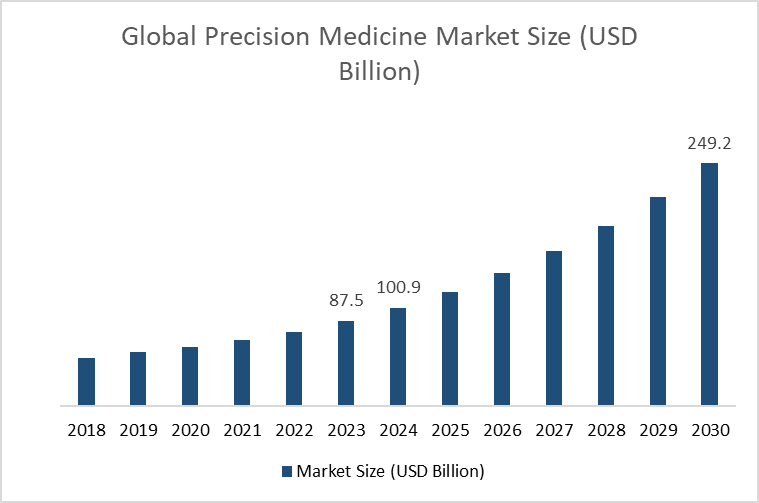
Due to the rise in adoption of this technology, the demand for precision medicine has increased globally, and is expected to reach USD 249.24 billion by 2030 with a 16.3% CAGR from 2024 to 2030.
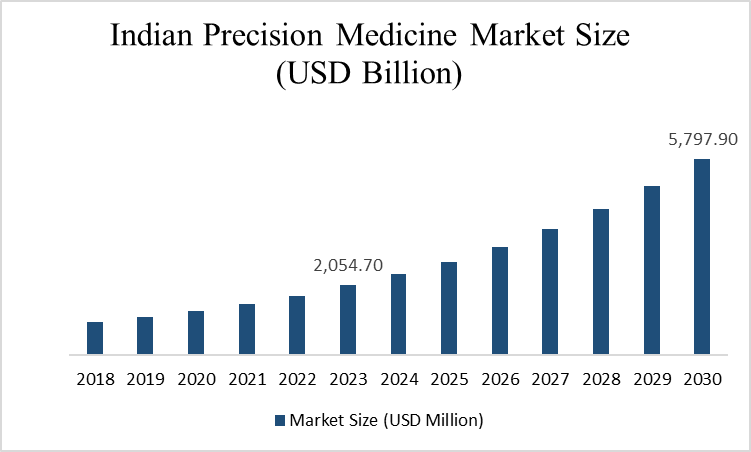
The Indian market size of precision medicine in the healthcare industry was recorded at USD 2,054.7 million in 2023 and is expected to reach USD 5,797.9 million between 2024 and 2030 with a 16% CAGR.
Conventional Medicine Vs Precision Medicine
| Aspect | Conventional Medicine | Precision Medicine |
| Treatment Approach | Same approach for most patients, one-size-fits-all | Personalized treatment based on individual patient data |
| Decision Basis | General symptoms and population averages | Genomics, lifestyle, medical history, and AI analysis |
| Medication Selection | The same drug is given to many patients | Drug selected based on genetic compatibility |
| Dosage | Standard dosage for all | Customized dosage per patient |
| Accuracy | Moderate accuracy | High accuracy and targeted results |
| Technology Dependency | Low | Depend on AI, genomics, cloud, and analytics |
| Disease Prediction | Reactive (treatment after disease occurs) | Predictive (early risk identification |
| Examples | General antibiotics, painkillers | Cancer targeted therapy, pharmacogenomics |
Real-World Examples & Research Trends
Several studies have been conducted, and results show that precision medicine provides better and faster health.
- A report published on the GlobalRPH website stated that studies show that genomics and personalised medicine result in ~85% better patient outcomes than a one-size-fits-all approach.
- The meta-analysis in JAMA Oncology shows that the rate of treatment has increased, from ~4.9% to ~30.6%, with precision medicine compared with traditional approaches.
- Several studies show that the reduction of adverse drug reactions can be achieved using genomic-guided therapy. An article published by the Australian Prescriber stated that up to ~30% adverse drug reduction was recorded by prescribing pharmacogenomic-guided medications.
Role of Genomics in Personalized Treatment
Genomics is the study of genes (DNA), which play an important role in healthcare. Two bodies with the same diseases can react differently to the same medication because they both have different DNA/genes. Therefore, in the precision medicine approach, each human’s genomic data analysis was done, and a personalized treatment plan was prescribed based on their genetics. As a result, the recovery will be faster compared to the traditional approach. The genomics and AI in healthcare will help to achieve:
- The right medicine for the individual patient.
- Reduce the side effects
- Deciding the correct dosage
- Supporting cancer and complex disease treatment
- Predicting future health risk
Studies show that AI and genomics have increased the number of solved genetic cases compared to traditional approaches across multiple cohorts. With some studies reporting up to ~45% reduction in diagnostic errors and strong evidence of enhanced performance in genomic interpretation
How Artificial Intelligence Enhances Precision Medicine
Artificial intelligence has played a vital role in healthcare. It enables a multimodal data integration system to obtain data from several sources, including wearable devices, electronic health records (EHRs), medical images, and laboratory reports, and generate more accurate diagnostics, personalized treatment strategies, and real-time patient monitoring.
- Integrating and analyzing high-dimensional health data.
- Detecting disease earlier and more accurately.
- Personalizing drug design & treatment plans.
- Supporting clinician decisions with predictive insights.
- Enabling adaptive, real-time patient monitoring.
- Streamlining clinical research and trial optimization.
- Transforming healthcare toward individualized, proactive care
Benefits of Precision Medicine
- Enhance patient treatment efficacy: With the help of precision medicine, doctors can easily predict upcoming risks related to patients’ health and give medication that works best, heal patients faster, and deliver clinical benefits.
- Reduced Side Effects: In conventional medicine, it is difficult to predict whether a prescribed drug’s side effects affect the patient or not. But in the case of precision medicine, the treatment plan is given to the patient by understanding genetic predispositions, which automatically reduces the risk of the drug’s side effects and makes it safer.
- More Accurate Diagnosis: This technology helps predict a more accurate diagnosis, providing genetic data and molecular insights, which allow doctors or researchers to classify diseases with greater precision.
- Enhanced Prevention & Early Intervention: By tracking individual patients’ lifestyles, genes, and history, it identifies high risk of disease, allowing for early screening or preventative strategies.
- Better Understanding of Disease: This helps doctors or researchers to gain deeper insights into diseases in various human bodies. Helps to understand the diseases in different human bodies and how they react to a particular treatment plan or rate of improvement, etc.
- Proactive vs. Reactive Care: This technology not only focuses on treating patients’ symptoms. Instead of focusing on patients’ symptoms, this technology works on how the patients’ disease will prevent progression.
- Healthcare System Efficiency: AI is already helping hospitals in various ways, from automating and reducing the burden to assisting doctors with the help of AI agents. Precision medicine helps healthcare systems by reducing unnecessary procedures and costs, and by allocating resources more effectively.
Challenges and Limitations
- High cost of genomic testing and targeted therapies
- Limited insurance coverage and reimbursement issues
- Complex data collection, storage, and integration
- Lack of standardized data formats and clinical guidelines
- Privacy, data security, and ethical concerns with genetic data
- Risk of genetic discrimination and consent challenges
- Shortage of trained professionals (genetics, bioinformatics)
- Difficulty integrating precision medicine into routine clinical workflows
- Genetic and biological complexity of diseases
- Limited representation of diverse populations in genomic databases
- Infrastructure gaps, especially in low-resource and rural settings
- Regulatory, legal, and policy challenges
- Potential to increase healthcare inequality
Future of Precision Medicine and AI
With precision medicine and AI, the world was their oyster. Several research studies are underway to maximize the impact of personalized medicine. Few healthcare organizations are adapting these technologies and generating better outcomes. The government and the research institute can work on the challenges of implementing precision medicine.
However, in India, the widespread adoption of this technology is expected to take a few more years. Nevertheless, the future of precision medicine is promising and holds potential for transforming the healthcare industry.
The government needs to invest in infrastructure, education, and research. With the support of the government, healthcare organisations, research institutes, and tech companies, India has the potential to revolutionize healthcare, delivering the best health outcomes for all.
Conclusion
Hospitals must shift from a traditional treatment approach to a personalized medicine approach. Several ongoing and previous research studies show that the outcomes of personalized medicine are better than those of standardized treatment approaches. Several startup companies in India are developing wearable devices that help monitor patients’ lifestyles and health conditions. However, hospitals may face several challenges in adopting this technology, including data privacy issues, ethical concerns, a shortage of skilled professionals, and high costs. The future of precision medicine will depend on further research, technological development, drug discovery, and improved clinical outcomes.
References: