

What if an Artificial Intelligence system can understand all types of data inputs, whether the data is in text, video, audio, or image format, and generate outputs, including audio, video, text, or image format? This is real, not a dream; text-based AI, such as large language models powering ChatGPT, is just scratching the surface. Multimodal generative AI is the next frontier where artificial intelligence can consume inputs of various data types, such as audio, video, images, or 3D models, and also generate outputs of any data type, including audio, video, or text.
In healthcare, multimodal AI systems obtain data as input from several sources, including wearable devices, electronic health records (EHRs), medical images, and laboratory reports, and generate more accurate diagnostics, personalized treatment strategies, and real-time patient monitoring.
In this article, we will discuss how multimodal AI works in diagnosis, market trends, types of data inputs, real-world examples, research trends, benefits, challenges, and limitations, the role of synthetic data in training multimodal AI, and the future of multimodal AI in healthcare.
Market Trends of Multimodal AI in Healthcare
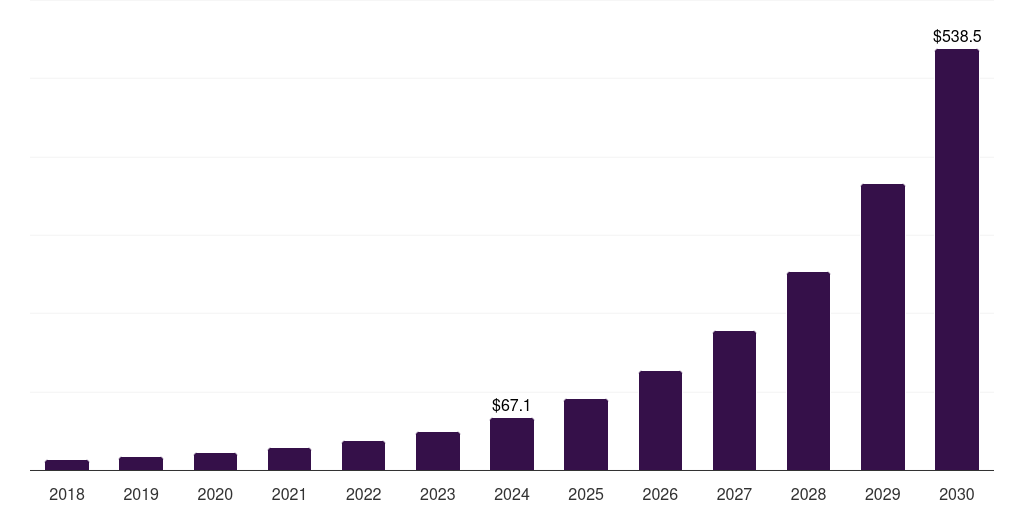
The Indian multimodal AI market trend was recorded at USD 67.1 million in 2024 and is predicted to generate revenue of USD 538.5 million by 2030. A compound annual growth rate of 42.5% is expected of India’s synthetic data generation market from 2025 to 2030.
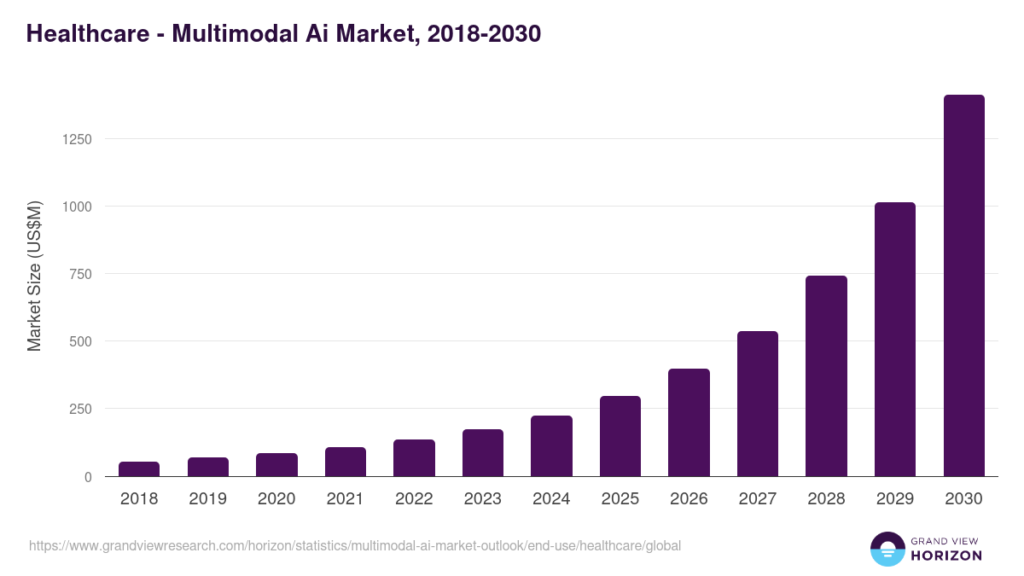
The global multimodal AI market trend was recorded at USD 225.1 million in 2024 and is predicted to generate revenue of USD 1,411.6 million by 2030. A compound annual growth rate of 36.6% is expected of India’s synthetic data generation market from 2024 to 2030.
Types of Data Used in Multimodal Healthcare AI
Data is the backbone of multimodal AI in healthcare. When integrated with a diverse range of data types, it provides a more holistic understanding of patient health, enabling improved diagnosis, treatment planning, and monitoring with these AI models.
- Medical Images: The most commonly used data type, it includes images from X-rays, MRIs, CT scans, pathology slides, optical coherence tomography(OCT) and fundus photography in ophthalmology.
- Clinical Text: Electronic Medical Records(EMRs), clinical notes, radiology lab reports, and pathology reports, all types of text-form notes, and documents related to patients.
- Time-Series and Sensor Data: Data from wearable devices, real-time vital monitors, electrocardiogram (ECG), and electroencephalogram (EEG) signals, glucose monitors, and accelerometers.
- Voice and Video Data: Models use these data modalities to analyze and read patients’ behavior, body language, and emotional cues that might be missed through other data formats. Here, data sources include patients’ and caregivers’ conversations, surgical footage, audio, and video recordings of patients.
- Genomic and Biological Data: This data is essential for precision medicines, as it provides insights into patients’ genetic profiles, proteins, metabolite profiles, biomarker data, and DNA/RNA sequencing data.
Real-World Examples & Research Trends
Many studies have been conducted and achieved results that multimodal AI improves diagnostic accuracy compared to single-modal AI.
- According to a report published by the International Institute of Clinical Research and Studies (IICRS), multimodal AI diagnoses give 15-30% higher precision compared to single modality analysis for rare disease diagnosis. Also, it reported a 6–33% performance gain across a large set of 14,324 independent models.
- According to a report published by the Nature Publishing Group, a multimodal approach increases performance accuracy from ~1.2% to 27.7% compared to using a single modality approach.
- A report published by the Nature Publishing Group evaluated that a chatbot-powered multimodal AI system diagnoses eye diseases using text and image input data, generating ~80% more accurate results compared to taking input only in text form.
- According to a report published on ResearchGate, real-time AI dashboards for ICU monitoring and alerting have improved by about 30% compared to prior systems.
- According to a report published by PubMed Central, the median critical alert turnaround time (TAT) to ICU, emergency, and IPD was reduced from 5 minutes to 3 minutes, which represents a 40% reduction in response time for ICU alerts and similar clinical areas.
- An article published by The Economic Times stated that a ~79% reduction of documentation time was achieved by using AI. It can help reduce doctors’ workload by fixing healthcare documentation in India.
Multimodal AI Use Cases in Healthcare
- Streamlined drug development: Multimodal AI in medicine research and development accelerates timelines by improving accurate target identification. Researchers can prioritize viable drug targets and design more effective therapeutic interventions earlier in the development pipeline. Using these models can reduce manufacturing costs, increase success rates, help research teams to generate new molecular structures, and predict drug interactions in a short period of time.
- Personalized and Predictive Care: These AI models track patients’ lifestyle, genetic information, history, and symptoms through wearable, real-time vital monitor devices. These models help forecast disease based on symptoms and create personalized treatment plans for an individual patient.
- Better patient outcomes: Earlier systems only understood one language, but things have changed now with the help of multimodal virtual assistants. Patients can interact in their native language, and these models can understand multiple languages and analyse their biometric inputs, which helps doctors to understand patients and achieve better results easily.
- Higher diagnostic accuracy: While treating a patient, doctors analyse multiple reports, including medical images, text reports, and the patient’s history. This is a time-consuming process. With the help of multimodal machine learning in healthcare, doctors can visualize patients’ health more accurately, diagnose diseases with more precision, and treat in a proper, fast, accurate, and reliable way. These models can help detect complex or rare conditions that single-modality approaches might miss.
- Reduce burden on caregivers: In healthcare, AI has already improved workflow efficiency, and integrating multimodal technology helps healthcare professionals focus on direct patient care. It automates administrative tasks, such as documentation and report generation, and streamlines clinical workflows like ER(Emergency Room) triage optimization and surgical planning.
According to a report published by Oracle Health, multimodal AI systems can reduce documentation workflow by up to 30%, directly reducing the burden on clinicians and enhancing their performance to focus on patients and provide better care.
Challenges and limitations of multimodal AI in healthcare
Data Privacy and Compliance: Data privacy is a significant concern in healthcare. The data used by the multimodal systems is stored in these systems. It is not easy to keep all this diverse data safe, always at high risk of data breaches and cyber attacks. You must follow standards and compliance such as the DPDP Act, GDPR, and HIPAA.
Data integration complexity: Connecting several devices and transferring data among them is a challenging task. Sometimes, seamless integration of these devices, such as EHRs, RIS, LIMS, HIMS, medical claims, pharmacy software, and wearable devices, is quite difficult due to the different formats and standards.
Model bias and reliability: We are still in the early phase of the AI models era. There is a high chance that the system can generate biased output because these systems are still learning. They don’t have data for complex and rare cases. So it’s important to double-check that the output generated is correct
High infrastructure cost: It is expensive to run and maintain a multimodal AI. To run this system, multiple technological resources are included, such as a 5G network, cybersecurity cells, cloud storage, high-power servers, and a GPU. Due to high running and maintenance costs, not every hospital can access this.
Regulatory approvals: The legal sanction processes are complex, costly, and time-consuming. Due to these challenges, small-scale hospitals are afraid to adopt this model.
Role of Synthetic Data in Training Multimodal AI
Synthetic data plays a crucial role in training multimodal generative AI. The data should be of high quality; if the data is biased or incomplete, the multimodal AI models will reflect these shortcomings. Also, it may lead to fairness issues in AI models. Here are a few points on how synthetic data is reshaping multimodal AI:
- Synthetic data enables faster AI model development
- Limited datasets can lead to slow AI innovation
- Helps in testing the accuracy and efficacy of medical tools
- Synthetic data helps simulate rare disease cases. It produces new combinations & scenarios
Synthetic data helps in medical research by providing large datasets
Future of Multimodal AI in Healthcare
In the coming years, we can see multimodal AI used on a large scale. The rise in demand for such models can accelerate development, allowing AI developers to create more intelligent, connected, and proactive tools that will revolutionize the healthcare industry. Here’s what we can expect in 2026 and beyond:
- Unified Foundation Models for Healthcare
- Digital Twins of Patients
- Ambient Intelligence in Hospitals
- Multilingual, multimodal Patient Interfaces
- Fully Autonomous Care Bots
- Precision Public Health
Conclusion
The rise in the adoption of healthcare artificial intelligence and machine learning devices/tools has increased gradually, with over 1250 FDA-approved tools by the year 2025, and is reshaping the industry. The multimodal AI models represent modern, novel methodology in healthcare. This technology has enhanced the care experience of human beings, making it personalized and proactive.
Despite these numerous benefits, the government, AI developers, hospitals, and healthcare providers must follow strict regulatory compliance. It is the beginning of a never-ending era where simple chatbot systems take multiple sources of real-time inputs and generate more correct and quicker results.