

Why Laboratory Software Feels Confusing
Buying laboratory software today is more confusing than ever. There are many new terms related to LIMS software available in the market, such as Laboratory Information Management System (LIMS), Laboratory Information System (LIS), Enterprise LIMS, and Electronic Lab Notebook (ELN), with which most buyers are unfamiliar. Additionally, we are unaware of the differences between these; each vendor believes its software is enterprise-grade, scalable, and Artificial Intelligence (AI) driven. That makes the scenario even more difficult for the buyer to choose one among all.
Which software is more advanced than the others is not the biggest question. The question is which software fits best with your requirements. A small pathology lab, a multi-location diagnostic chain, a pharma QC lab, and a research lab all have different requirements.
In this blog, we will understand the difference between LIMS and LIS, when a buyer needs an enterprise system, and the questions to focus on when choosing software.
Understanding the Basics: LIMS, LIS, ELN & Enterprise Systems
LIMS
A Laboratory Information Management System (LIMS) is specialised software that manages, tracks, and streamlines laboratory operations. LIMS serves as the digital backbone of modern laboratories, handling everything from sample registration and tracking to data analysis, quality control, and regulatory compliance. Some vendors offer a real-time dashboard with Turnaround Time (TAT) tracking and delay alerts in their software.
LIS
It is a software that coordinates workflow mainly for hospitals and clinics, like managing, storing, updating, billing, and tracking patients’ medical data. It does not provide full automation and does not support bidirectional analyzer integration. It is suitable for buyers with less patient volume.
ELN
An ELN is a digital version of a notebook where scientists or researchers can record experiment procedures, observations, calculations, results, and conclusions digitally. Generally, it is useful in research & Development (R&D) labs, pharmaceutical research teams, biotechnology companies, and academic research institutions.
Enterprise System
The Enterprise LIMS system is a fully integrated laboratory environment where all systems are interconnected and work together, such as testing, documentation, compliance, and manufacturing. Typically, multi-location pharma companies need this kind of software.
LIMS vs LIS: The Fundamental Difference Buyers Must Understand
| Aspect | LIMS | LIS | ELN | Enterprise LIMS |
| Primary Focus | Sample tracking & workflows | Clinical/pathology patient data | Experiment documentation | Large-scale lab operations |
| Best For | QC labs, industrial labs, research | Diagnostic & pathology labs | R&D labs | Multi-site labs, pharma, manufacturing |
| Data Managed | Samples, results, reports | Patient tests, billing | Research/experiment notes | Samples + enterprise data across labs |
| Compliance & Regulation | High (GMP / GLP / ISO) | Moderate (Clinical standards) | Low | Very high (global standards) |
| Integration | Instruments, ERP, MES | Hospital systems, HIS | Collaboration tools | ERP, HIS, Instruments, analytics |
| Typical Deployment | Cloud / On-prem | Cloud / On-prem | Cloud | Cloud / On-prem |
| Use Case Example | Stability testing | Pathology test reporting | Protocol tracking | Multi-site regulated quality control |
| Complexity Level | Medium | Low-Medium | Low | High |
| Typical Buyer | Pharma, Quality Control, biotech | Diagnostic chains, hospitals | Research groups | Large enterprises, regulators |
GMP – Good Manufacturing Practice
GLP – Good Laboratory Practice
ISO – International Organization for Standardization
ERP – Enterprise Resource Planning
MES – Manufacturing Execution System
HIS – Hospital Information System
QC – Quality Control
The Laboratory Digital Maturity Model
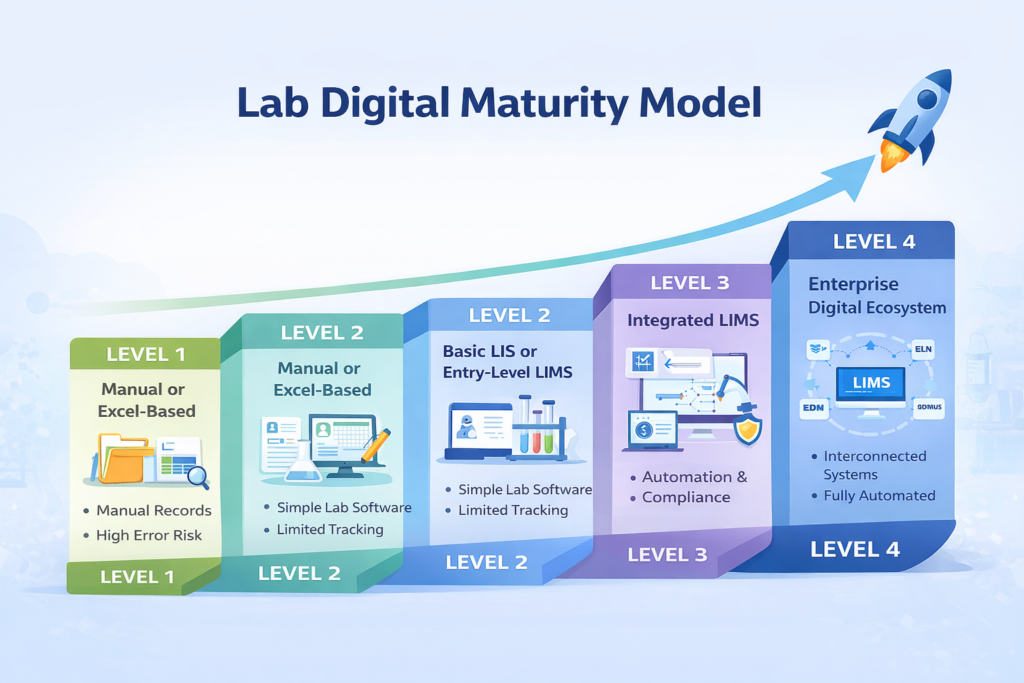
Level-1: Manual or Excel-Based Operations
This level is common among small and newly established laboratories. The risk of errors is higher at this stage because all data is entered manually, such as sample tracking, reporting, and data entry. Retrieving data during audits can be a time-consuming process.
- Level-2: Basic LIS
The software is used for basic functions for report generation, sample entry, and tracking. Best suited for small pathology labs, clinics, and hospitals with limited sample volumes.
- Level-3: Integrated LIMS
The software is best suited for medium to large laboratories that often require workflow automation, instrument integration, audit trails, and compliance management features. It helps by managing data into a structured, secure, and accessible form.
- Level-4: Enterprise Digital Ecosystem
This version is required by multi-location organizations and highly regulated industries such as pharmaceuticals. At this level, all systems (LIMS, ELN, SDMS) are interconnected, and laboratory results directly influence manufacturing decisions, inventory control, and supply chain operations.
When do you need an Enterprise LIMS?
An Enterprise LIMS workflow is not limited to sample tracking; instead, it represents a complete digital laboratory ecosystem.
It typically includes multiple interconnected modules:
- Scientific Data Management System (SDMS): It is used for capturing and securing raw data from instruments.
- ELN: It is used for documenting experiments and research workflows.
- LIMS: It is used for managing samples, test allocation, results, scheduling, and approvals.
- DMS or Quality Module: It is used for document control, Corrective and Preventive Action (CAPA), deviations, and compliance management.
The Enterprise LIMS is not necessary for all, but only for those organizations that operate labs in multiple locations and need automation for high sample volumes.
It becomes critical for organizations where laboratory operations are closely integrated with manufacturing or supply chain systems, as test results directly impact production release decisions. Additionally, industries with strict regulatory requirements, such as pharmaceuticals, benefit from Enterprise LIMS to ensure compliance, data integrity, and audit readiness.
Smart LIMS software demo questions
The buyer must be familiar with the questions and know the clear requirements before taking a live demo. Here is the list of a few questions that a buyer must ask:
- Do these platforms provide data backup & disaster recovery?
- Do these systems integrate with Picture Archiving and Communication System (PACS) and Radiology Information System (RIS)?
- Does it flag abnormal trends using historical patient data?
- What is the maximum concurrent user capacity tested?
- Can Turn Around Time (TAT) be monitored department-wise?
- Does the system support auto-flagging of critical values?
- Is bi-directional analyzer integration supported?
AI Features in Modern LIMS Platforms
From predictive analytics to intelligent automation, AI is changing the way organizations operate and deliver value. We have seen its adoption on every platform. Similarly, before exploring a LIMS software, users must know the AI features in modern LIMS, such as:
| LIS | LIMS | Enterprise LIMS |
| Data Automation | Automated Data Capture & Entry | All LIMS AI features |
| Pattern Recognition | AI-Driven Data Structuring & Knowledge Graphs | Integrated AI Across Modules |
| Predictive Insights | Predictive Analytics & Trend Detection | AI-Enhanced Decision Support |
| Built-in AI Assistants | ||
| Intelligent Workflow Optimization |
Conclusion
Choosing the right laboratory software is not about selecting the most advanced or feature-rich system. It’s about selecting the one that aligns best with your laboratory’s specific needs, scale, and future goals.
By understanding the core differences between LIMS, LIS, ELN, and Enterprise LIMS, and evaluating your position within the laboratory digital maturity model, you can make a more informed and strategic investment. Additionally, asking the right questions during demos and assessing AI capabilities ensures that your chosen system is not only relevant today but also future-ready.
Ultimately, the right laboratory management software acts as a growth enabler, improving efficiency, ensuring compliance, enhancing data accuracy, and supporting better decision-making. A thoughtful selection today can set the foundation for a scalable, digital-first laboratory tomorrow.