

Expert insights on non-communicable diseases (NCDs), rural healthcare access, telehealth adoption, NGO funding, AI in healthcare, and gaps in India’s medical governance
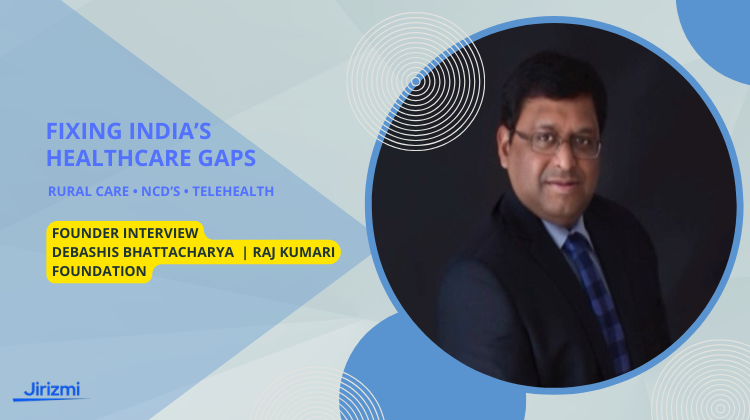
A trained surgeon, former Global Director at Novo Nordisk, and now NGO leader, Dr. Debashis Bhattacharya returned to India in 2024. His focus today spans rural healthcare, rare diseases, mental health, and strengthening how NGOs operate and communicate.
He speaks directly about what’s working, what isn’t, and where India needs structural change.
Key Takeaways
- NGOs often deliver strong results, but poor communication keeps their work invisible — and invisibility reduces funding.
- Rural India carries a high burden of non-communicable diseases (NCDs), but late diagnosis leads to worse outcomes.
- Telehealth works well for screening and triage but depends on basic infrastructure and local support.
- India has highly skilled surgeons, but lack of enforceable protocols leads to inconsistent practices.
- Drug repurposing offers a faster, cheaper path for rare disease treatment, but regulatory delays slow progress.
- CSR funding is increasingly outcome-driven, but NGOs struggle to present their impact clearly.
- AI in healthcare can improve access and efficiency, but cannot replace trained professionals.
Founder Background
Interviewer:
You started as a surgeon and then moved into pharma. What led to that shift?
Dr. Debashis:
During my training in the UK, my mentors encouraged me to think beyond surgery. At that time, I didn’t agree , I thought they were pushing me away from a clinical path.
But I took a sabbatical, explored other options, and joined Novo Nordisk. That changed my perspective completely.
In surgery, you treat one patient at a time. In pharmaceutical medicine, you can influence outcomes for thousands or even millions. That scale of impact was compelling.
Interviewer:
What did your role at Novo Nordisk involve?
Dr. Debashis:
I worked in drug safety and eventually became Global Director of Human Risk Management and Pharmacovigilance.
It was high-responsibility work , monitoring how drugs perform in real-world settings and ensuring patient safety across markets.
The scale was global, and the decisions carried significant consequences.
Interviewer:
After reaching that level, why return to India?
Dr. Debashis:
There were personal reasons initially- family health. But over time, the question became larger: what is the purpose of all this experience if it doesn’t benefit your own country?
India has highly capable individuals. What we lack is strong, consistent systems.
I came back because I felt I could contribute to building those systems, especially in healthcare and NGOs.
Rare Diseases & ICMR
Interviewer:
What did you observe about rare diseases in India?
Dr. Debashis:
It’s a serious and under-recognised problem. Treatments are extremely expensive, and most families don’t have institutional support.
Unlike countries with structured healthcare systems, Indian patients often rely entirely on personal resources.
Interviewer:
What approach did you take?
Dr. Debashis:
I worked on drug repurposing studies using existing approved drugs for new indications in rare diseases.
This approach reduces both cost and development time, making treatment more accessible.
We submitted multiple proposals to ICMR, and the initial response was very positive.
Interviewer:
Where do things stand now?
Dr. Debashis:
The proposals are still under evaluation.
That reflects a broader challenge as institutional processes in India move slowly. While the intent may be strong, execution timelines can delay real impact.
For patients with rare diseases, time is critical. These delays are difficult to accept, but they are a reality.
Employee Health & Workforce Wellness
Interviewer:
You’re building an employee health programme in Chennai. What gap are you addressing?
Dr. Debashis:
In India, most companies treat employee health as an annual event ( a checkup once a year).
There is no follow-up, no tracking, and no early intervention.
In contrast, systems in the West focus on continuous monitoring. Health is managed over time, not just assessed periodically.
That’s the model I’m trying to build here – a longitudinal approach to employee health.
Interviewer:
Are companies receptive to this idea?
Dr. Debashis:
Some are, but many still see preventive health as an optional expense.
The reality is simple: healthier employees are more productive, stay longer, and reduce long-term costs.
The challenge is shifting mindset from reactive care to preventive care. That change takes time.
Rajkumari Foundation
Interviewer:
What did you find when you joined the Rajkumari Foundation?
Dr. Debashis:
The work on the ground was strong and in some cases, exceptional.
But there was no structure, no documentation in a usable format, and no external visibility.
As a result, their impact remained largely unknown.
Interviewer:
Can you give an example?
Dr. Debashis:
In one project, they achieved a 500-gram weight gain in 15 days among severely malnourished adolescent girls.
That is a meaningful clinical outcome.
But it was documented only in an internal report that no external stakeholder ever saw.
Without visibility, even strong outcomes don’t translate into funding and without funding, programmes cannot continue.
Interviewer:
What changes have you made?
Dr. Debashis:
We focused on structure and communication:
- Converting field reports into scientific papers
- Building partnerships with institutions
- Expanding into AI-based cancer screening
- Strengthening documentation and data reporting
- Improving visibility through digital platforms
These steps help translate work into measurable, visible impact.
Interviewer:
What is your long-term goal for the organisation?
Dr. Debashis:
To position it as a professional, data-driven organisation.
The word “NGO” should not imply informal or unstructured work.
It should signal credibility, measurable outcomes, and transparency similar to a high-quality consulting organisation.
That is what attracts serious funders and partners.
Funding & Operations
Interviewer:
How do you manage teams across multiple states?
Dr. Debashis:
We operate with a small central team and hire field teams on a project basis.
Each project has its own funding source, and teams are built accordingly.
When a project ends, the team is dissolved.
This model allows flexibility and keeps operations aligned with funding.
Interviewer:
What are your main funding sources?
Dr. Debashis:
Primarily CSR funding from corporates, along with government-linked bodies such as DMFT.
We also receive support from specific public sector organisations for targeted projects.
Government Collaboration
Interviewer:
What has been your experience working with state governments?
Dr. Debashis:
It varies significantly.
Some officials are proactive, supportive, and solution-oriented. Others require constant follow-up.
It’s important to understand that outcomes often depend more on individuals than on the system itself.
Interviewer:
Any state that stands out positively?
Dr. Debashis:
Tamil Nadu.
There is structured engagement, regular communication, and willingness to collaborate across sectors.
That kind of institutional support makes a significant difference.
Interviewer:
What mistakes do NGOs make when engaging with the government?
Dr. Debashis:
The biggest mistake is poor communication.
NGOs often present detailed clinical or technical reports.
But decision-makers want clarity, not complexity. They want answers to four questions:
- What problem are you solving?
- What have you achieved?
- What do you need?
- What outcomes will follow?
If those answers are clear, engagement becomes much easier.
Telehealth & Rural Access
Interviewer:
Is telehealth effective in rural India?
Dr. Debashis:
Yes, particularly for screening and triage.
It allows patients in remote areas to access specialists they would otherwise never reach.
Interviewer:
What limits its expansion?
Dr. Debashis:
Infrastructure.
Telehealth requires more than internet access , it depends on roads, electricity, and local healthcare workers.
Without these, scaling becomes difficult.
Interviewer:
What is the biggest gap today?
Dr. Debashis:
Limited participation from specialists in routine consultations.
Most engage only in serious cases.
To address this, we may need policy interventions or incentives that encourage broader participation.
Surgical Standards & Governance
Interviewer:
How do Indian surgeons compare globally?
Dr. Debashis:
Technically, they are very strong.
High patient volumes lead to rapid skill development, often faster than in Western systems.
Interviewer:
Then where is the problem?
Dr. Debashis:
Lack of enforceable protocols.
Guidelines exist, but there is no strong regulatory mechanism to ensure adherence.
Interviewer:
What does that mean in practice?
Dr. Debashis:
It can lead to inconsistent decision-making including unnecessary procedures or premature adoption of complex techniques.
Without standardisation and accountability, patient risk increases.
NCDs & Rural Healthcare
Interviewer:
Are NCDs really common in rural India?
Dr. Debashis:
Yes. Conditions like diabetes, hypertension, and cancer are widespread.
The assumption that rural populations are less affected is incorrect.
Interviewer:
What is the key difference compared to urban areas?
Dr. Debashis:
Timing of diagnosis.
Urban patients are diagnosed earlier due to regular access to healthcare.
Rural patients often seek care only during advanced stages, leading to worse outcomes and higher costs.
Interviewer:
What are you doing in this area?
Dr. Debashis:
We are expanding AI-based cancer screening programmes in Tamil Nadu.
The goal is early detection, which significantly improves outcomes.
Mental Health & AI
Interviewer:
Tell us about your work with Infiheal.
Dr. Debashis:
I advise the organisation on strategy and clinical alignment.
They are building AI-based tools for mental health support.
Interviewer:
How effective are these tools?
Dr. Debashis:
They are useful for mild to moderate conditions and for people who might otherwise receive no support.
However, they cannot replace trained therapists especially in complex or severe cases.
Interviewer:
Is mental health stigma reducing in India?
Dr. Debashis:
Yes, particularly among younger populations.
Public conversations and visibility have helped normalise these discussions.
Interviewer:
What about access to care?
Dr. Debashis:
Access remains limited.
Even well-developed systems struggle with capacity. India still needs significant expansion in mental health services.
Prevention and early intervention offer the highest impact right now.
CSR & Communication
Interviewer:
How has CSR funding evolved?
Dr. Debashis:
It has become more structured and outcome-focused.
Funders want measurable results, not just activity reports.
Interviewer:
What is your key advice for NGOs?
Dr. Debashis:
Invest in communication.
Present your work clearly, with defined outcomes and structured data.
Reports should be easy to understand and focused on impact, not technical detail.
This shift alone can significantly improve funding opportunities.
Personal Motivation
Interviewer:
What drives you to continue this work?
Dr. Debashis:
The combination of skills I bring is more relevant here than in more developed systems.
That creates an opportunity to make a meaningful impact.
Interviewer:
What would you say to professionals considering returning to India?
Dr. Debashis:
Be prepared for slower processes.
But the nature of impact is very different and often more tangible.
If you stay engaged and build the right partnerships, the work can be deeply rewarding.