

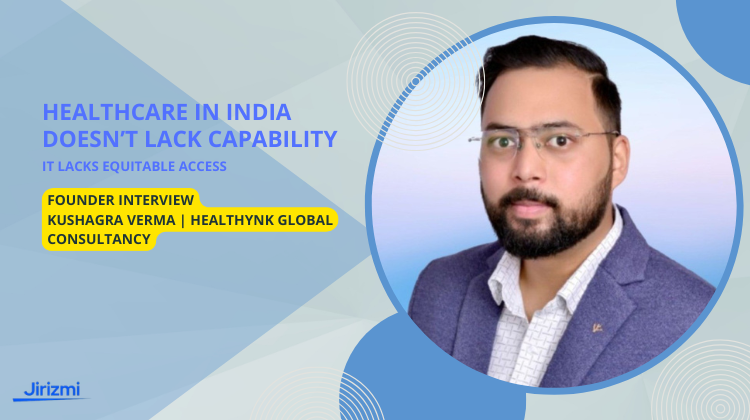
Insights from Kushagra Verma, Founder of Healthynk, on Fixing the System
India’s healthcare system sits at a paradoxical intersection, world-class doctors and infrastructure on one side, and deep accessibility, affordability, and distribution gaps on the other.
In this conversation, Kushagra Verma, founder of Healthynk, breaks down what’s really happening behind the scenes. From struggling 100–200 bed hospitals and broken supply chains in Tier 2 and Tier 3 cities to the hype vs reality of AI in healthcare, the discussion goes far beyond surface-level insights.
Kushagra shares how most hospitals fail not due to lack of patients, but due to weak financial planning, lack of strategic leadership, and misplaced trust dynamics. He also highlights why healthcare startups struggle to convert pilots into revenue and what it actually takes to build trust with doctors.
At its core, this interview is about one thing: building a healthcare ecosystem that is accessible, affordable, and trustworthy not just in metros, but across Bharat.
Key Takeaways
- Healthcare challenges in India are less about capability and more about distribution and accessibility gaps.
- Most mid-sized hospitals (100–200 beds) struggle with profitability due to poor financial planning and lack of business acumen.
- Doctor-led branding limits hospital scalability and investor confidence.
- Tier 2 and Tier 3 healthcare ecosystems suffer from unstructured supply chains and lack of vendor systems.
- AI adoption in healthcare is slow due to trust deficits, not technology limitations.
- Healthtech startups fail to scale because they build products without deeply understanding hospital workflows.
- India has the potential to become a global healthcare hub but only with system-level collaboration between government, hospitals, and technology providers.
Founder Journey & What Healthynk Is Building
Interviewer
Let’s start with your journey. What are you currently building, and what problem are you trying to solve?
Kushagra
From my experience, I’ve seen that many people don’t really understand how healthcare works. Because of this, they often feel scared of hospitals and the whole system.
Right now, I lead a healthcare company called Healthynk, where we operate at the intersection of healthcare delivery, capital, and technology.
We work closely with hospitals, healthcare startups, and investors to unlock scalable growth across the ecosystem. On the provider side, we enable hospitals to expand sustainably by aligning them with the right financial structures, digital infrastructure, and operational strategies.
At the same time, we partner with healthcare innovators and global healthtech companies to help them enter and scale within the Indian market through structured, on-ground execution.
Our broader goal is to build a healthcare ecosystem that is not only accessible and affordable, but also economically sustainable—because today, for a large part of India, a single medical emergency can wipe out years of savings.
Role of Digital Health & Long-Term Vision
Interviewer:
You mentioned digital health. How central is that to your vision?
Kushagra:
It’s absolutely critical.
India is geographically vast, and we simply don’t have enough specialist doctors distributed evenly. Digital health, whether through telemedicine or AI can bridge that gap.
We’re actively trying to bring global AI healthcare companies into India to strengthen the ecosystem. The idea is to ensure that no patient is denied care due to location constraints.
My long-term vision is to spend the next 20 years building India into one of the world’s leading healthcare hubs, accessible, affordable, and reliable.
Hospital Strategy & Infrastructure Model
Interviewer:
What types of hospitals are you currently working with?
Kushagra:
Our primary focus is on hospitals with 100+ beds, especially those that can scale into 500 or even 2000-bed institutions.
We’re building a network where these hospitals act as central hubs within a 200 km radius. Around them, we plan to develop satellite centers, primarily trauma and stabilization units.
This is important because India consistently loses patients during the “golden hour” due to a lack of nearby facilities.
Ground Reality of Healthcare Access
Interviewer:
Can you give a real-world example of this challenge?
Kushagra:
Absolutely.
I’m originally from Uttarakhand. Recently, a 19-year-old boy suffered a cardiac arrest in a village about 30 km from Almora. He was taken to a primary health center, but no actionable treatment was possible due to lack of infrastructure.
By the time he reached the nearest Base hospital, it was too late.
This is not an isolated incident. It happens every day across India.
Operating Model & Geography
Interviewer:
You operate from Almora but work nationally. How does that setup work?
Kushagra:
Yes, we’re based out of Almora. I moved back to India about a year ago to build this ecosystem from the ground up.
We operate remotely but travel extensively across the country. Our work is both national and increasingly global.
The Profitability Myth of Hospitals
Interviewer:
There’s a perception that hospitals are highly profitable. What’s the reality?
Kushagra:
That perception is only partially true.
Tier 1 hospitals in metros—yes, they are profitable and operate with strong EBITDA margins.
But Tier 2 and Tier 3 hospitals, especially in the 100–200 bed range, struggle significantly.
Most of these hospitals are started by doctors who are excellent clinicians but lack business acumen. They invest 50–70% of their personal savings and then try to recover costs by increasing patient charges.
Initially, they might perform well. But over time, competition increases, trust erodes, and they start declining.
Trust Deficit in Healthcare
Interviewer:
So trust plays a big role?
Kushagra:
A huge role.
In India, trust in doctors is fragile. One negative outcome , even if not entirely the doctor’s fault can damage reputation significantly.
This leads to a cycle where hospitals try to recover financially, patients feel overcharged, and trust breaks further.
In fact, we have observed the trend that every month, around 40–50 hospitals in the 100–200 bed category shut down. That’s a massive churn.
Government Schemes: Intent vs Execution
Interviewer:
Are there no government support systems to prevent this?
Kushagra:
There are schemes, but awareness is low and execution is weak.
Take Ayushman Bharat, for example. On paper, it’s excellent. But payments to hospitals are often delayed by years. In Uttarakhand, some hospitals haven’t received payments for the past three years.
So while intent exists, implementation gaps remain.
Leadership Gap in Hospitals
Interviewer:
What about leadership? Do hospitals hire professional CEOs?
Kushagra:
Rarely.
You’ll find operational managers, but not strategic leaders.
Most managers handle day-to-day operations but lack long-term vision. Hiring a strong strategic leader requires investment, and many doctors hesitate due to concerns over authority and control.
This lack of leadership is a major reason why even large private institutions struggle with profitability and innovation.
Branding: Doctor vs Institution
Interviewer:
Let’s talk about go-to-market strategies. Should hospitals build around doctors or the brand itself?
Kushagra:
In India, most smaller hospitals rely on doctor-led branding.
That’s risky.
If one doctor becomes the face of the hospital, the entire system becomes dependent on them. This limits scalability and reduces investor confidence.
Also, patients often associate trust with a single doctor, not the institution. So, if something goes wrong elsewhere in the hospital, the entire brand suffers.
Rise of “Instagram Doctors”
Interviewer:
And now we also have “Instagram doctors.”
Kushagra:
Exactly.
Some doctors are great at content but sometimes creating a gap between digital visibility and clinical depth. Patients are influenced by social media and may make decisions based on visibility rather than expertise.
At the same time, genuinely skilled doctors who don’t create content often remain under-recognized.
This imbalance affects patient outcomes and hospital credibility. There is currently limited regulatory clarity around medical content creation.
Supply Chain Challenges in Bharat
Interviewer:
How structured is the supply chain ecosystem for hospitals in India?
Kushagra:
There are essentially two parts to it.
In metro cities, large hospital chains have structured supply systems.
But in Bharat,Tier 2 and Tier 3 regions, there’s no proper supply chain. Hospitals rely on multiple vendors, often unorganized, and spend significant effort just managing procurement.
This inefficiency directly impacts cost and quality of care.
AI Adoption in Healthcare
Interviewer:
What about technology adoption, especially AI?
Kushagra:
Doctors are open to technology, but hesitant about AI.
There’s a perception that AI will replace doctors or take away jobs. This fear creates resistance.
In terms of spending, hospitals allocate less than 5% of their revenue to technology. That’s extremely low.
Can AI Improve Margins?
Interviewer:
But AI can improve margins, right?
Kushagra:
Absolutely.
AI can improve diagnostics, ICU management, and operational efficiency. It can significantly enhance EBITDA margins.
But the real challenge is not technology, it’s trust. Unless AI integrates seamlessly into clinical workflows and demonstrates clear ROI, adoption will remain limited.
Why Healthtech Startups Struggle
Interviewer:
Why do healthtech startups struggle to scale?
Kushagra:
Because they build products in isolation.
Most startups are product-focused, not ecosystem-focused. They don’t spend enough time understanding hospital workflows or doctor needs.
They run pilots, but those pilots rarely convert into long-term revenue.
The reason is simple: the product doesn’t truly solve the hospital’s problem.
The Right Approach: Co-Creation
Interviewer:
What’s the solution?
Kushagra:
Co-creation.
Startups should build products alongside 15–20 hospitals during the development phase. Use real data, real workflows, and real challenges.
This creates better products, builds trust, and generates word-of-mouth validation within the medical community.
Doctors trust peer recommendations far more than sales pitches.
Investor Mindset in Healthtech
Interviewer:
What about investor pressure? Does that affect product development?
Kushagra:
Not really.
Most AI investors understand that returns will take 10–15 years. The issue is not pressure, it’s mindset.
Founders are often too focused on their product and not enough on real-world application.
Also, access to hospitals is limited, which makes collaboration difficult.
Healthynk’s Long-Term Strategy
Interviewer:
What’s your long-term strategy for Healthynk?
Kushagra:
We don’t focus on building standalone products—we focus on identifying and scaling the right solutions within the healthcare ecosystem.
Our goal is to identify high-quality solutions globally and scale them in India. We want to build a Healthcare ecosystem first in India and later globally that is accessible, affordable, and trustworthy.
Policy & Government Role
Interviewer:
Any role the government needs to play?
Kushagra:
A significant one.
For example, India imposes around 40% import duty on medical equipment. That increases costs for hospitals and ultimately for patients.
If we want affordable healthcare, policy alignment is critical.
Final Takeway
This conversation highlights a crucial reality: India’s healthcare challenges are not due to lack of talent or intent, but due to fragmentation.
From trust deficits and financial mismanagement to disconnected innovation and policy gaps, the system needs alignment.
And as Kushagra points out, the path forward isn’t just better technology, it’s better collaboration between hospitals, startups, investors, and policymakers.
India doesn’t need more isolated healthcare innovation—it needs alignment. The next phase of growth will be driven by those who can connect capital, care delivery, and technology into one functioning system.