

Pranav was a boy with a heart defect whose surgery had been declined by multiple surgeons. The doctors were unsure about the surgical approach and what should be done so that the child’s life could be safe. Here comes the role of additive manufacturing: an exact model of his heart was recreated, allowing surgeons to practice the procedure multiple times and to understand the process. It has been more than a decade, and the boy is now healthy and living a normal life.
There are many stories similar to this whose lives have been changed by 3D-printed parts. Over the past few years, 3D printing has emerged as a transformative technology in the healthcare industry. The number of centralized 3D printing facilities grew from a few in 2010 to over 100 by 2019.
Industries Using 3D Printing Today
The aerospace & defence industries were early adopters of 3D printing, starting in the late 1980s/early 1990s. It is now widely adopted by various other sectors, notably Healthcare (implants, surgical guides), Manufacturing (prototypes, jigs, fixtures), Consumer Goods (footwear, eyewear), Construction (homes, models), and Education.
As adoption across industries grows, the healthcare sector is emerging as one of the most promising areas for 3D printing innovation. This growing relevance is also reflected in market trends and projections.
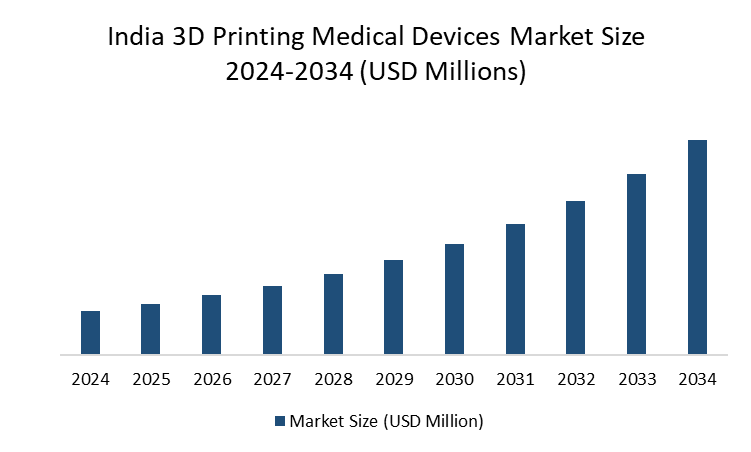
The Indian 3D printing medical device market is projected to grow from USD 145.34 million in 2024 to USD 680.92 million by 2034 at a 16.70% CAGR.
Expert Opinions and Industry Quotes
Industry leaders and experts have also emphasized the transformative potential of this technology.
The CEO of InfraTrac, Dr. Sharon Flank, said, “This technology is ready now — enabling safer, smarter, and more individualized dosing through quality-driven, predictive, and easy-to-verify 3D printing at the point of care.
Joseph DeSimone, professor of translational medicine and chemical engineering at Stanford University and co-founder of the digital manufacturing company Carbon, has said, “This technology has led to new designs that before were impossible”.
Let’s now explore how this technology is applied in real-world healthcare settings.
3D Printing Solutions in Healthcare
Anatomical Models
- 1:1 scale, patient-specific replicas
- Used for surgical planning and OT preparation
- Non-implantable, polymer-based
Surgical Guides & Jigs
- Used intraoperatively for cutting, drilling, and screw placement
- Made from biocompatible polymers
- Reduce surgery time and patient trauma
Patient-Specific Implants
- Custom-designed to match the exact anatomy
- Made from titanium
- Provide accurate fit, better aesthetics, and reduced intraoperative adjustments
Pediatric Cranial Helmets
- Designed for skull deformities in pediatric patients
- Customized for individual growth patterns
Technologies in 3D Printing
FDM (Fused Deposition Modeling)
- Plastic models (PLA/ABS)
- Low cost, fast
- Planning & demo models
SLA (Stereolithography)
- High accuracy & smooth finish
- Complex anatomy is clearly visible
- Surgical guides & detailed models
SLS (Selective Laser Sintering)
- Strong nylon parts
- Sterilizable surgical guides
- Functional components
Metal 3D Printing (DMLS / SLM)
- Titanium implants & prosthesis
- Porous structure → better bone integration
- Permanent implants
Materials used in 3D Printing
- PLA / ABS – demo & planning
- Resin – guides & high-detail models
- Nylon (PA12) – strong surgical guides
- Titanium (Ti6Al4V) – implants & prosthesis
Beyond general applications, 3D printing is making a significant impact across multiple medical specialties.
Use of 3D Printing Technology in Different Specializations
The primary input for all cases is DICOM data from CT and MRI scans, which are segmented to create an accurate 3D digital anatomy. Virtual design should be shared with the surgeon for approval. Once finalized, the design is sent for 3D printing.
Here is a detailed walkthrough of the products or techniques of 3D printing that are used in particular specializations, such as:
The primary input for all cases is DICOM data from CT and MRI scans, which are segmented to create an accurate 3D digital anatomy. Virtual design should be shared with the surgeon for approval. Once finalized, the design is sent for 3D printing.
Here is a detailed walkthrough of the products or techniques of 3D printing that are used in particular specializations, such as:
Orthopaedics
Orthopaedics is the specialization where 3D printing is used the most. From planning a procedure to customizing a patient-specific anatomical model, this technology can do it all. It also supports custom limb prosthesis, orthopaedic implants, braces, surgical tools & jigs. It will provide more accurate 3D printed surgical guides for knee replacement, spine screws, and osteotomy.
Cardiology
Around 300,000 cardiac surgeries are performed annually in India. Around 58,000 valvular heart procedures and 40,000 congenital surgeries are performed annually.
3D printing technology enables the creation of patient-specific anatomical models for pre-procedure planning and risk reduction. It also develops customized implants, surgical guides & tools. This can significantly reduce surgical risks, shorten operation time, and is helpful in complex congenital surgeries where anatomy varies dramatically.
Neurosurgery
For complex surgeries, 3D printing technology enables the creation of patient-specific anatomical models for surgical planning and training. Custom implants, screws, and guides are developed using a 3D printer for better precision, improved patient communication, and innovative tissue-engineered solutions for skull and nerve repair.
Oral and Maxillofacial
Oral and Maxillofacial Surgery is the second most specialized field that utilizes 3D printing products and technology. Jaw reconstruction, facial trauma implants, cranioplasty (skull plates), and cutting & positioning guides are performed under Oral and Maxillofacial specialization using 3D printing products.
According to a report published in India in 2023, approximately 126.7 million dental procedures were performed annually. The most common dental procedures in India are dental cosmetic procedures and dental fillings. Products such as Crowns, bridges, aligners, surgical guides, dentures, and dental models are used in dentistry.
Orthopedic Oncology
Orthopedic Oncology involves highly complex and planned surgeries. Cases such as bone tumors, soft tissue tumors, benign tumors, and metastatic bone disease are treated. This technology is used to develop patient-specific anatomical models for pre-procedure planning and risk reduction, custom bone implants/prosthesis, 3D printed surgical cutting guides, and custom jigs, holders & trial implants. This helps surgeons achieve more accurate tumor removal, limb salvage instead of amputation, shorter surgery time, better implant fit & recovery.
According to a report published by Onco, which is an India-based cancer care platform and healthcare technology company, around 4000 new bone cancer cases are reported annually in India.
Interventional Radiology
3D printing technology allows surgeons to plan pre-procedure, reduce risk, and rehearse or simulate procedures. It also supports the development of 3D-printed vascular phantoms for accurate planning of embolization, angioplasty, and stent placement.
In addition, patient-specific devices and accessories, such as needle and catheter guides, are used in Biopsy, ablation, and drainage procedures.
Hepatology
Around 2 million deaths occur annually due to liver diseases worldwide, and over 268,000 deaths occur in India. 3D printing technology enables the creation of patient-specific liver models for pre-procedure planning, which directly reduces surgical risks for complex cases. These models enable precise tumor localization, vascular mapping, and assessment of remnant liver volume, leading to safer resections.
Urology
The 3D technology enables surgeons to enhance their pre-procedure planning by creating patient-specific anatomical models, better planning, realistic surgical simulation, and patient education in complex cases such as the removal of kidney tumors, partial nephrectomies for kidney tumors, and nerve-sparing prostatectomies for cancer. Custom implants can be created for procedures like partial nephrectomy, prostatectomy, and pyeloplasty.
Pulmonology
It helps surgeons by creating patient-specific anatomy models for pre-procedure planning and risk reduction. Airway stents and splints, peroperative models, and bioprinted tissues are the key applications. Students can work on these models and practice procedures under the supervision of professors to enhance their skills before working on actual patients.
Spine Surgery
3D printing technology helps surgeons to enhance preoperative planning, create custom implants, and improve surgical accuracy for complex deformities, tumors, and fusions.
Considering these advancements, it is clear that 3D printing is reshaping the future of healthcare.
Conclusion
3D printing technology in healthcare has huge potential. One of the ultimate goals in the healthcare field is to print living biological tissue, which can repair or even replace human anatomy. This technology may eventually be able to provide complex systems, including functioning organs.
Today, large hospitals in metro cities are leading the adoption of 3D printing. However, a clear adoption gap still exists in small- and mid-sized hospitals. In the coming years, we can witness the transformative adoption of this technology on a large scale. A few homegrown companies are already working in this field and are more likely to emerge in the next few decades.
3D printing technology is transforming patient care, improving surgical confidence, and restoring hope for complex and previously inoperable cases. It has a promising future in the healthcare industry.
Reference
https://pmc.ncbi.nlm.nih.gov/articles/PMC10734340