

In today’s era, technology is replacing legacy methods across industries, streamlining workflows and reducing manual effort. In healthcare, it has fundamentally reshaped the ecosystem by strengthening clinical, operational, and patient-care processes.
One of the latest technologies revolutionizing healthcare in India is 3D printing, also known as additive manufacturing. 3D printing in orthopedics and dental implants has emerged as a powerful medical tool, enabling greater precision, personalization, and efficiency in surgical procedures. In dentistry, it plays a crucial role in producing high-precision dental models and implants, enhancing surgical accuracy, reducing operating time, and improving patient outcomes. Similarly, in orthopedics, this technology enables the fabrication of patient-specific implants, surgical guides, prosthetics, and advanced tissue engineering scaffolds significantly improving surgical outcomes and accelerating patient recovery. Overall, 3D printing is transforming how doctors plan, customize, and perform complex surgeries
Let’s understand how 3D printing is reshaping orthopedics and dentistry in India, the ongoing research, emerging innovations, homegrown companies, and future potential.
Trends In the Indian Market for 3D Printing MedicalDevices
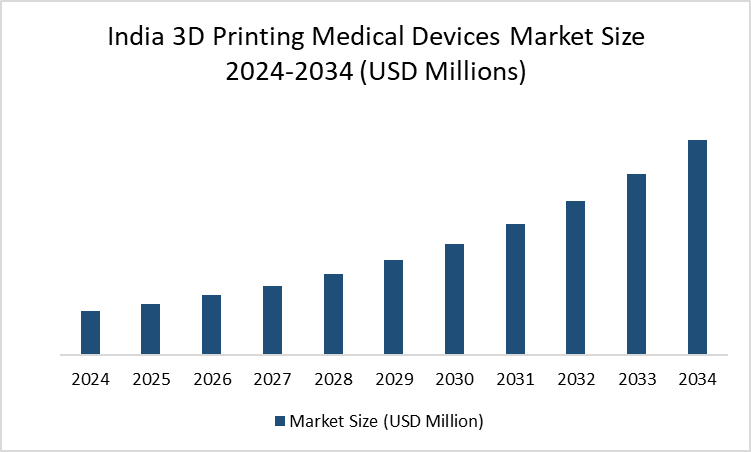
The Indian 3D printing medical device market size was valued at USD 145.34 million in 2024, and is expected to reach USD 680.92 million by 2034. The market is expected to grow with a CAGR of 16.70% from 2025-2034.
Global Market Trends for 3D Printing in Healthcare
The global 3D printing market size was valued at USD 20.37 billion in 2023 and is projected to reach USD 88.2 billion by 2030, growing at a CAGR of 23.5% from 2024 to 2030. North America is the largest market for 3D printing, and the Asian market is the fastest-growing market, projected to expand at the highest CAGR during 2024 – 2030.
Applications of 3D Printing in Dentistry in India
Dentistry is the biggest and most rapidly expanding medical 3D printing market in India due to high demand for cosmetic dentistry and affordability. Here is the list of applications that are in high demand in dentistry.
- Crowns
- Veneers
- Brideges
- Dental implants
- Aligners
- Surgical guides
- Retainers
- Dental Models/ Study Models
- Dentures (Complete/Partial)
- Splints and Night Guards
- Custom Trays
Applications of 3D Printing in Orthopedics in India
India reports a high number of road accidents and fracture cases, and 3D printing is the biggest beneficiary in Orthopedics. According to a report published by Data for India, road accidents are a major public health concern in India, with over 450,000 reported accidents in 2022. Here is the list of applications that are in high demand in orthopedics.
- Custom bone implants for trauma
- Patient-specific surgical guides
- Pre-surgical planning models
- Prosthetics and orthotics
- Custom Bone Plates and Screws
- Joint Replacement implants
- Spine Cages / Spinal Fusion Implants
- Custom Limb Salvage Implants
- Anatomical Models for Patient Education
- Training and Teaching Models
Benefits of 3D Printing in Dentistry
| Benefits | Impact |
| Cost Reduction and time | Reduced the need for manual labor Reduced waste More affordable treatment while maintaining quality Reduce the treatment time of the patient |
| Precision & Fit | Feel more natural due to the exact fit Last longer Reduce complications |
| Speed & Efficiency | Faster fabrication, which directly reduces waiting time Enables immediate functional recovery |
| Flexibility & Versatility | Wide range of applications across specialties Easily customizable according to patient needs. |
| Quality & Consistency | Reduce manual labor so less chances of error Easier to remake devices. |
| Patient satisfaction and comfort | Patients found these fits more natural, comfortable, and functional Fewer adjustments needs |
Benefits of 3D Printing in Orthopedics
| Benefits | Impact |
| Patient-specific implants and prostheses | Better anatomical fit Fewer complications Lower implant mismatch Reduced revision surgery rates. |
| Custom surgical guides | Higher surgical accuracy Faster procedures Fewer intraoperative errors Improved implant placement |
| Shorter operative time | Lower anesthesia duration Reduced surgical fatigue Improved efficiency Faster patient turnover |
| Reduced intraoperative blood loss | Safer surgeries Less transfusion requirement Faster recovery |
| Material flexibility | Ability to match material with clinical need, such as load-bearing, lightweight, radiolucent. Personalized reconstruction solutions. |
Key Challenges in India
Regulatory / Approval Uncertainty & Gaps for 3D-Printed Implants
In India, although many hospitals are using 3D printed implants but there is a lack of a dedicated regulatory approval pathway. For wide adoption, approved standards and regulatory clarity will likely be needed.
Standardization, Quality Assurance & Material / Process Variability
Without clear, strict laws, standardizations, quality assurance, and materials, hospitals are hesitant to use these implants for critical operations. They need official standards, rulebooks that ensure these customized implants are safe and reliable every single time.
Cost, Expertise & Infrastructure Needs (Especially Affecting Smaller or Mid-Level Hospitals)
The cost of 3D printing is less for some implants, but overall still high because of software, hardware, materials, and trained personnel. So many rural hospitals and clinics may find it difficult to adopt, which slows down the market penetration of 3D printed implant.
Insurance / Reimbursement & Market Readiness
Adoption of 3D printing implants is still in its early phase in India, so many insurance companies and government schemes may not reimburse because of a lack of standards. This leads to limited patients and hospitals.
Bio-Safety, Long-Term Outcomes & Lack of Long-Term Data
3D printing is a new technology, so many doctors still feel cautious about adopting this technology rather than routine practice, except in selective cases such as complex trauma and reconstructive surgery.
Indian Companies Working in Medical 3D Printing
3D Incredible
3D Incredible is a Pune-based company specializing in metal 3D printed patient-specific implants (cranial, maxillofacial, orthopedic) and surgical guides. They are a significant player in the high-precision medical space in India.
Imaginarium
Imaginarium is one of India’s largest and most comprehensive 3D printing service bureaus. They have a dedicated healthcare division providing patient-specific solutions, anatomical models, and tools to hospitals and medical institutions.
Aurum3D
Aurum3D offers medical-industry 3D printing services, including anatomical models, surgical instruments, dental/orthopaedics, implants, and prosthetics.
XLO 3D Patient Solution
XLO 3D patient solution customized 3D printed medical implants for orthopaedic, such as modular shoulder, elbow, and radial-head replacement systems.
Fabheads Automation
Fabheads Automation Focuses on advanced composite and other manufacturing solutions, which include supporting specific medical device needs.
Morphedo
Morphedo is an Indian startup providing on-demand 3D printing services for various industries, including medical prototyping and small-batch manufacturing.
ARC India
ARC India is a major service provider with a strong focus on custom anatomical models for surgical planning and solutions for the dental industry (e.g., aligners, crowns).
Future of 3D Printing in Indian Healthcare
Driven by the growing demand for personalized treatment and rapid technology adoption, the future of additive manufacturing in India looks highly promising. Wider adoption across hospitals and surgical centers will accelerate once clear government regulations, standards, and clinical guidelines are in place, removing hesitation and enabling 3D printing to become part of routine patient care.
Today, large hospitals in metro cities are leading the adoption of 3D printing, particularly in orthopedics, dental implants, oncology reconstruction, and complex trauma cases. However, a clear adoption gap still exists in small- and mid-sized hospitals.
Looking ahead, 3D printing is expected to move from a niche, high-end capability to a widely accessible medical tool. Falling printer costs, improved biocompatible materials, and stronger collaboration between engineers and clinicians will play a key role in making this technology mainstream across India’s healthcare ecosystem.
As a result, advances in bioprinting, such as 3D-printed bone, cartilage, and functional tissues, could further transform surgical care, positioning India as a global leader in affordable, patient-specific medical technologies.
In short, 3D printing is no longer an experimental technology it has become an established and proven solution in healthcare. It delivers greater precision, improved bone reconstruction, speed, and accuracy, leading to faster recovery times and better clinical outcomes. In the years ahead, increased affordability will further enhance the patient experience.
The Indian market is growing rapidly, with hospitals, startups, and MedTech innovators accelerating adoption across clinical use cases.
References
https://www.image3dconversion.com/blog/how-3d-printing-is-transforming-dental-lab
https://www.expertmarketresearch.com/reports/india-3d-printing-medical-devices-market