

Introduction
Over the years, it has been difficult for organizations to scale their technology processes and operations across multiple sites, so they have developed techniques such as DevOps, DevSecOps, and Site Reliability Engineer (SRE). Still, these tasks seem very challenging, like managing development-related infrastructure and infrastructure upgrades. In the past, for software development, the traditional waterfall approach was used. This process takes so much time and involves writing the code, testing, debugging, and later deployment. The previous stage must be completed before the start of the next step. This method faces many issues, such as overlapping phases, difficulty in accommodating change requests, no feedback path, and causing a delay in delivering IT services to its users. The failure of the waterfall approach led to the evolution of agile methodology. The agile approach focuses on getting smaller teams to collaborate and aligning development with customer needs and trends. Although agile methods still face various difficulties, such as ineffective collaboration with larger groups, slow bug fixes, rolling out new updates and features, and causing delays in the delivery process. Even this agile methodology still lacked on a few fronts; poor resource planning, limited documentation, fragmented output, no finite end, and delays in the delivery process. As a result, the organization faced an extreme need to minimize downtime and delay delivering solutions. However, this changed with the emergence of DevSecOps, DevOps, and SRE as a natural solution for this challenge.
Let’s briefly introduce DevOps, DevSecOps, and SRE methodology and further explain the difference between these methodologies.
DevOps
DevOps is the combination of terms development and operations. This tool is designed to increase an organization’s ability to deliver applications and services much faster than traditional methodologies. According to a report, the market size of DevOps surpassed $4 billion in 2019 and is ready to develop at more than 20% CAGR between 2020 and 2026. In the US, the market for DevOps is estimated at US$3.2 billion in the year 2021. While in China, the experts have predicted that the market size of DevOps will reach $1.9 billion, trailing a CAGR of 23% by the year 2026 over the analysis period. Japan and Canada are each forecast to get a projected market size of 17.2% and 18.1%, respectively, in the analysis period. Finally, Germany is predicted to grow at approximately 18.9% CAGR in Europe.
DevOps enables both team software developers(devs) and operations (ops) to work together to conceive, build and deliver secure software. In this, developers and operations teams work together across the entire software application life cycle, from development and testing through deployment to operations.
While DevOps generally apply some standard methodologies, these include the following:
● Continuous delivery (CD) and continuous integration (CI) tools, with priority on task automation.
● Real-time monitoring, configuration management, incident management, and collaboration platforms, these systems and tools support DevOps adoption.
● Cloud computing, containers, and microservices are implemented simultaneously with DevOps methodologies.
Benefits of DevOps
DevOps breaks the barriers between development and operations teams, so they are no longer siloed and work more efficiently across the entire lifecycle. Let’s explore some benefits of DevOps:
Speed: This model enables developers and operations teams to move at high velocity to innovate applications for customers faster. Businesses adapt to changing markets better and grow more efficiently at driving business results. Teams take the privilege of services and then release updates to them quicker; microservices and continuous delivery.
Collaboration: More effective teams build under DevOps cultural model to emphasize values such as ownership and accountability. The developers and operations teams participate closely, share many responsibilities, and combine workflows. It saves time and reduces inefficiencies.
Scale: Organizations can operate and manage their infrastructure and development processes at scale. Automation and consistency reduce risk and help organizations manage complex or change systems efficiently. Infrastructure as code is used to manage your development, testing, and production environments in a repeatable and more efficient manner.
Reliability: While maintaining a positive experience for end users, it ensures the quality and infrastructure of application updates or changes so you can reliably deliver at a more rapid pace. Continuous integration and continuous delivery practice are used to test whether each change is functional and safe.
Fast delivery: DevOps helps organizations to improve products faster and
build a competitive advantage.
DevSecOps
DevSecOps is an engineering strategy that allows development, security, and operations teams to collaborate and eliminate silos. DevSecOps focuses on automating and delivering secure software and infrastructure to production quickly and frequently. The goal is to inject security into all stages of the software development workflow.
In the last few years, cyber-attacks have rapidly increased many folds, and it is undeniable by the most prepared organization the risk of undergoing a cyber attack. Even zero-day attacks compromised more than 65% of the total attacks, and threats to cloud-based applications have remarkably increased.
According to a report, DevSecOps global market size was valued at $2.79 billion in 2020, and experts predicted that from 2021 to 2028, it is expected to expand at a compound annual growth rate of 24.1% CAGR. The rise in cybercrimes and the growing internet penetration rate are the factors that contribute to the growth of the market. In addition, the rising number of businesses and applications drifting towards the cloud, 5G rollouts, and Internet of Things deployment is expected to commend the DevSecOps market.
It is an extension of DevOps with a clear focus on security. At the end of the development approach, vulnerability assessments are usually performed. As a result, more communication ( arguments or discussions to find some solutions) between teams, more costly solutions, and resource waste.
Benefits of DevSecOps
It allows better association and communication among teams which increases efficiency and agility. Now, let us discuss some benefits of DevSecOps:
Recognition of vulnerabilities: DevSecOps team can speed up the detection and resolution of open source concerns. To detect vulnerabilities and compliance problems, developers gain access to real-time analytics before they result in significant data loss or application harm. DevSecOps allows vulnerabilities to be integrated into the developer’s workflow instead of waiting until the end of development to implement security. It minimizes application vulnerabilities by identifying vulnerabilities in the early stages of the software development lifecycle.
Support from multiple vendors: To enable a multi-vendor, multi-cloud technology environment, DevSecOps provides a framework for integrating workflows. An application-centric view of the infrastructure is provided by DevSecOps automation. DevSecOps helps to build a trustful relationship with the organization by increasing traceability.
Reliable security methods: DevSecOps offers more speed and agility to security teams. By investing and reducing the chance of human error, DevSecOps engineers improve the reliability of critical security operations.
Assured compliance: Compliance is an essential factor in this area. Compliance helps organizations by protecting client data and supporting them to avoid massive fines and public criticism.
Self-service: A self-service DevOps portal builds technology, infrastructure, tools, configuration, and design patterns. The self-service platform is easy to deploy, a solution that lets organizations provide end-to-end digital services. In addition, application owners are permitted to handle network aspects user- friendly using the low-code or no-code capabilities that DevSecOps provide.
Site reliability engineering (SRE)
Their engineering teams originated the site reliability engineering model at Google in 2003 and are credited to Ben Treynor Sloss. SRE incorporates various aspects of software development into IT operations by providing a unique approach to application lifecycle and service management. In addition, SRE was developed to create IT infrastructure architecture that meets the needs of enterprises- scale systems.
SRE has become popular among IT and business technology individuals and leaders across service providers, enterprises, and automation vendors. As per the 2021 Upskilling Report, SRE is a must-have process and framework skill, as said by 47% of respondents. The SRE adoption in 2021 was at 22% and is predicted to double in 2022.
According to a report, the job growth for a site reliability engineer is estimated to increase 21 percent by 2028, and the annual average base salary for a site reliability engineer in the US is $102,103 (July 2022). SRE includes some core responsibilities:
- Developing, configuring, and deploying software to be used by operations
- teams
- Handling and supporting issues like escalation
- Conducting and reporting on incident reviews
- Change managementDeveloping system documentationDetermining and validating new features and updates.
Benefits of SRE
SRE is a software engineering approach where the SRE team members solve operations and IT problems using the software as a tool. Now have a look at the benefits of SRE on your business:
Better metrics reporting: Site reliability engineering provides transparency through measuring and monitoring efficiency, productivity, the occurrence of bugs, and service health. While improved metrics offer the SRE teams to find the best solution to the problems of areas of improvement and the information is also valuable for the sales and marketing department.
Early prevention of issues that can affect end users: Fast development and shipment of products increase the business and raise various problems such as vulnerability detection and disregard bugs. Through proactive troubleshooting, SRE teams remove these problems.
More time, more value: Developers have more time to focus on creating new features while SRE teams detect issues and enable the developer’s team to resolve them in advance. SRE teams help developers to produce a product with higher value to the end users.
Continuous cultural improvement: To optimize services and product reliability, it offers an ongoing search for areas of improvement.
Increased automation: Automation increases the reliability of services or systems by continuously finding the best way to automate and modernize the workflow of a product engineer. Detecting bugs and vulnerabilities improves their workflow.
Meeting customer expectations: SRE concept is always trying to reach the customer expectation by utilizing metrics such as SLA, SLI, and SLO. As a result, the product is more reliable in terms of ROI.
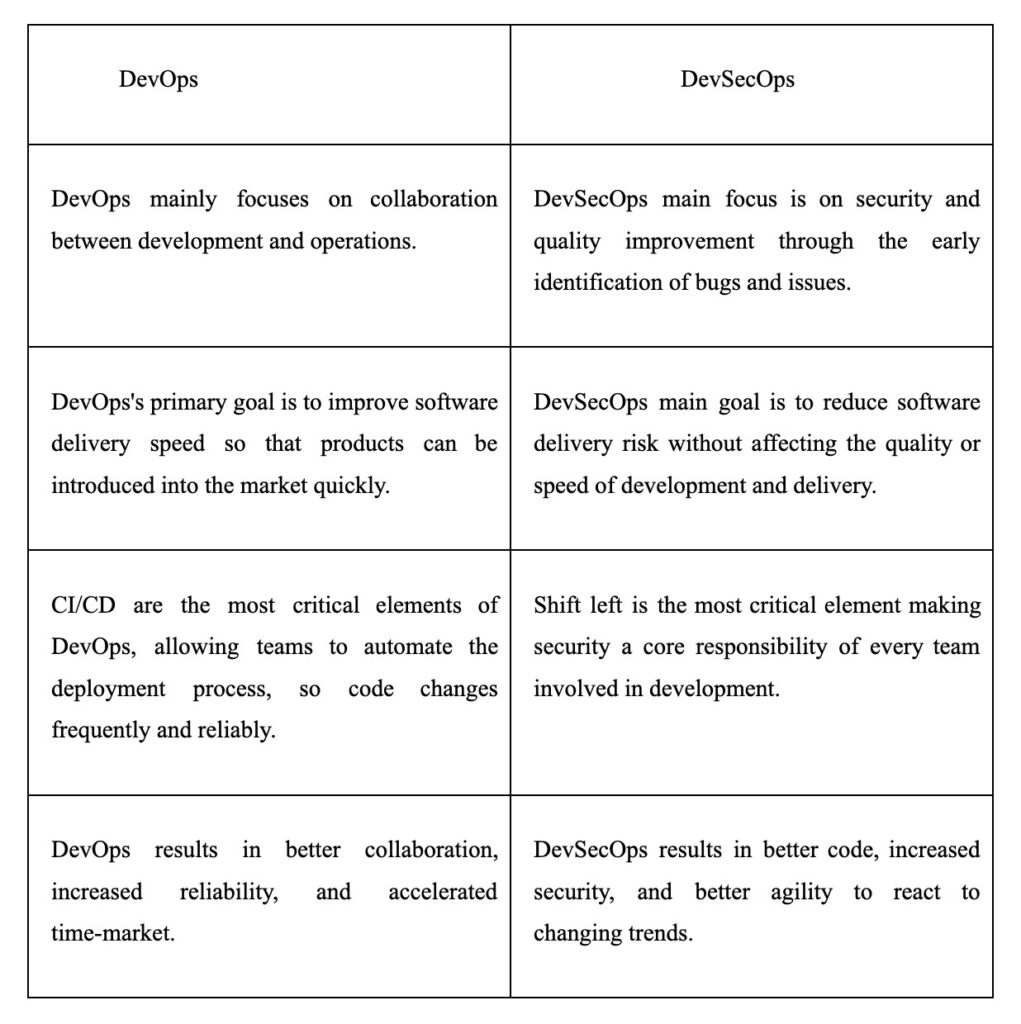
Difference between DevOps, DevSecOps, and SRE
DevSecOps is just an extension of DevOps. They are slightly different from each other.
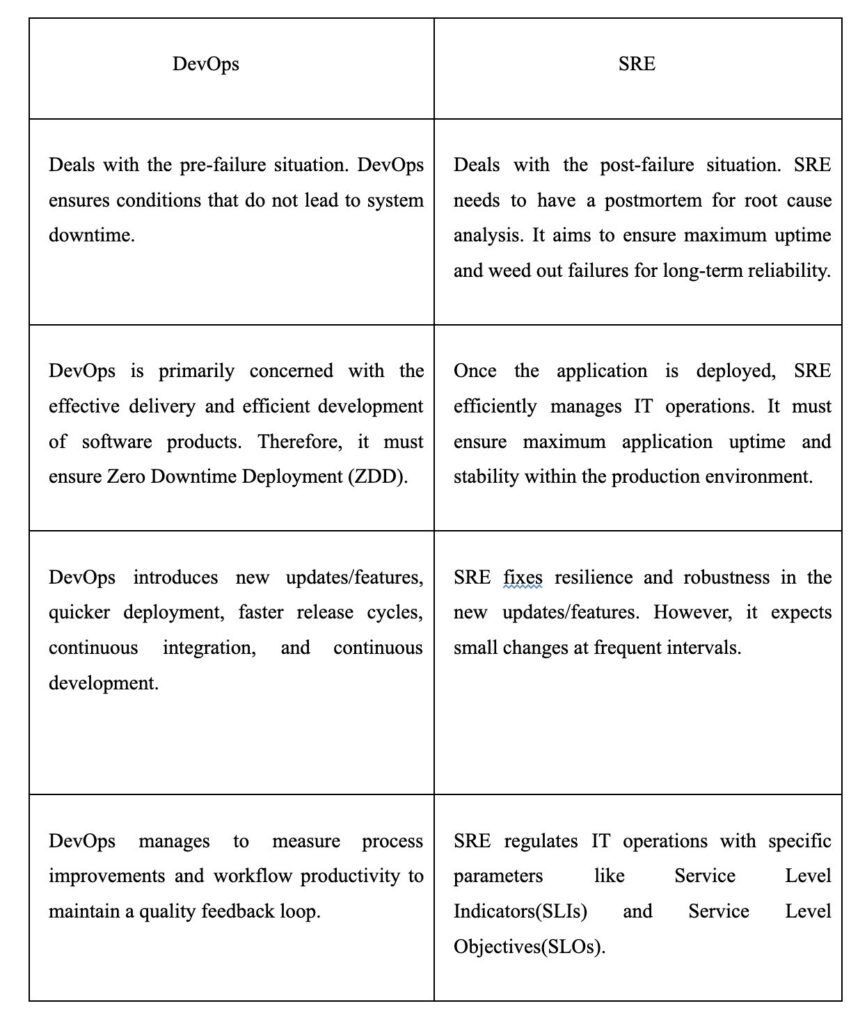
DevOps and SRE both have different views and goals. So let’s have a look at their differences.
Conclusion
We can say that businesses must adapt and keep up with modern technological approaches for application development. DevOps supports the agile process. DevSecOps is the modified approach of DevOps. As DevSecOps practices, integrate security objectives with the DevOps. SRE culture prioritizes reliability.
These three methodologies should not be considered approaches competing against each other, and it’s all up to the organization, its need, and its philosophy. These methodologies work towards the same goal with almost the same tools but slightly different focuses