

To develop a country, not only does its economic development need to improve health, but also social reform, health policies, public health services, and preventive measures, which are not possible without government support. Population health analytics(PHA) and population health management(PHM) play a vital role in understanding the health condition of the entire country.
Primarily, PHA is the detailed study of population health data that helps to identify, analyze, and understand the health risks of the majority of the population of a country. It helps identify rising diseases, age, gender, and area, etc. It makes the emerging patterns, declining trends, and insights previously hidden in healthcare data.
Similarly, PHM is primarily focused on a specific group of people who need early care before the outbreak of diseases, and take preventive measures, using insights from analytics.
Understanding the health condition of such a large population, which is around 1.4 billion, is not an easy task; therefore, the role of population health becomes even more crucial for India.
In this blog, we will examine the growth of the population health market and its end-user landscape, including the US population health software market and its top 5 companies. Why is there limited growth of such a market in India, and what is the demand and buyers gap, and the company’s name?
A Market Yet to Be Born: Population Health Analytics in India
In India the population health market management/analytics market is almost non-existent (only 1.9 billion of addressable opportunity in an adjacent space in 2023 ) since India’s B2B health software market is still in nascent stages which is ripe for for early- mid stage only VC fund investments while in US the B2B health software space is 10x more mature and has large funded players (like Innovacer, Persivia, etc). Indian population health analytics space is basically composed of analytics companies essentially consuming tonnes of patient data and slicing and dicing it for departmental insights in particular ( Caresoft, Karexpert, etc ).
Also, here population health is monitored primarily by the government, with limited involvement from the private sector, largely because private providers lack sufficient incentives to invest in population-level health improvements.
In India, there is no complimentary reimbursement structure provided by the government if the healthcare provider is providing more value for money and better care than its counterparts while in US the CMS (Centers for Medicare & Medicaid Services) has a value based care framework which motivates the providers to provide better care than its counterparts to generate more revenue and reimbursed better from insurance plans when they provide better service to accommodate for population health management and analytics in entirety.
The Indian government will need to initiate reforms aimed at expanding insurance coverage across the patient population. As hospitals begin to treat a larger share of insured patients, insurance companies will play a greater role in monitoring hospital services prior to reimbursement.
Key Government Initiatives with Value-Based Elements
1. Ayushman Bharat – Pradhan Mantri Jan Arogya Yojana (PM-JAY)
2. Health and Wellness Centres (HWCs) under Ayushman Bharat
3. State-Level Innovations
Global Population Health Market
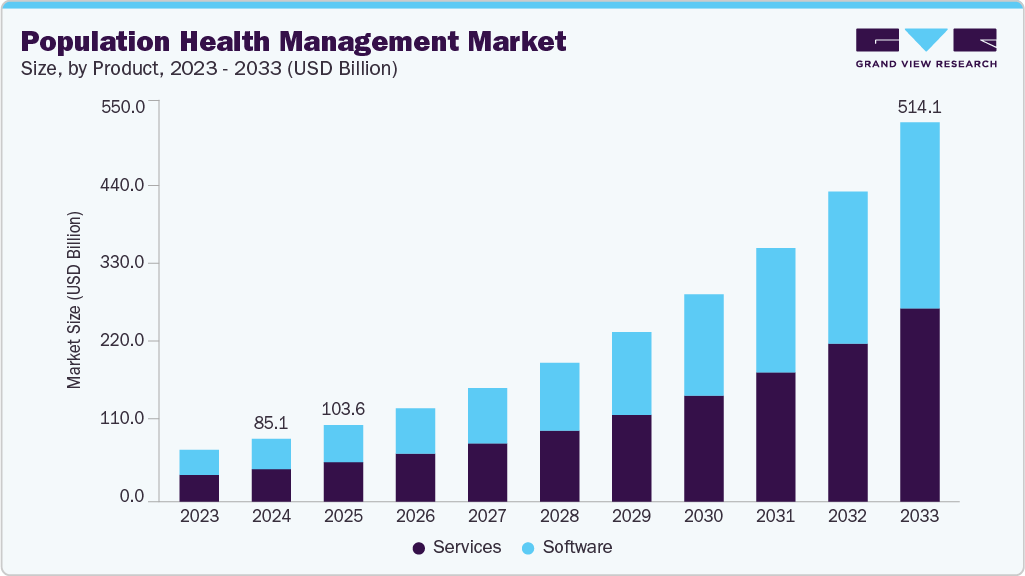
By the year 2033, it is estimated that the global population health management market will reach USD 514.12 billion, which was recorded as USD 85.15 billion in the year 2024. The growth rate is a CAGR of 22.2% from 2025 to 2033.
Similarly,
The global population health analytics market is expected to reach USD 30.04 billion by 2034, and in 2025, it was recorded at USD 3.60 billion. The growth rate is a CAGR of 27.70% from 2025 to 2033.
The market value of the Population Health Market of the U.S. and India
| Aspect | The U.S | India |
| Population Health Management | 2024: USD 36.04 billion. 2033: USD 210.18 billion CAGR= 21.70% | 2023: USD 1,973 million 2030: USD 8,916.6 million CAGR= 24% |
| Healthcare Analytics Market | 2024: USD 15.85 billion. 2030: USD 59.68 billion CAGR= 24.90% | 2024: USD 1,573.9 million 2033: USD 7,735.3 million CAGR= 18.4% |
Primary End-User for Population Health Data
Generally, population health data is needed to understand the health analytics of a country. This health analytics data is useful in many areas, including:
- Healthcare providers:
- To track chronic diseases and manage them.
- Improve the quality of healthcare to obtain better health outcomes.
- Government & Public Health:
- The government takes action on the early needed areas by running health programs.
- With the help of these tools, the government can monitor the outbreak and track the improvement.
- Researchers networks:
- Pharmaceutical companies use it to discover drugs and monitor drug effectiveness.
- Researchers can analyze large-scale health data and understand its impact in the real world.
- Value-based care organizations& networks:
- To focus on value, not volume, and focus on quality by identifying at-risk patients.
- Take proactive care management and reduce unnecessary costs.
- Insurance Companies:
- Insurance providers utilise data and identify the most effective and cost-efficient strategies for managing their health and preventing hospitalisations and claims in the long run.
Why the US Built a Standalone Population Health Software Market
The U.S has a larger population health market than India. The key drivers accelerating the adoption of the population health market are the rise of chronic diseases and the shift to a value-based care model.
The U.S federal government spends around $1.9 trillion on healthcare in the FY 2024, and healthcare organizations are investing heavily in technologies that integrate clinical, financial, and operational data, enabling a comprehensive view of patient health and risk stratification.
Many factors encourage startups or companies to build a standalone population health software market, including:
- The shifts from volume-based to value-based care models in the US: Population Health Management software is becoming an essential tool for providers and payers aiming to achieve better patient engagement, efficient care coordination, and improved chronic disease management.
- Chronic Disease Burden: According to an article published by The Economic Times in the U.S majority of people are suffering from chronic diseases such as heart diseases, diabetes, cancer, obesity, and hypertension. Across 52.5% to 59.5% young adults are suffering from at least one chronic disease. If some serious health measures are not addressed by the government timely then by the year 2050, more than60% of adults will have some form of cardiovascular disease or related condition.
- Cost Control & Efficiency: The population health tools help healthcare organizations, governments, pharmaceutical companies, and insurance companies identify rising diseases, high-risk patients, and reduce unnecessary resource use. All end-users can use the tools in the best way and reduce unnecessary expenditure.
- Regulatory & Government Push: The U.S. government encourages its healthcare organizations to adopt digital health records by taking initiatives like
- HITECH(Health Information Technology for Economic and Clinical Health Act)) Act
- 21st Century Cures Act
The U.S Top Population Health Software players
- Innovaccer: It is one of the leading companies due to its ability to combine different health data from multiple EHRs, claims, labs, and other systems and convert this into actionable insights.
- Arcadia: Arcadia is a population health analytics and value-based care solution provider that helps organizations by providing detailed analytics of unified data.
- Health Catalyst: Health Catalyst is a standalone population health analytics and value-based care provider.
- ZeOmega: Provides a comprehensive population health management platform (Jiva) with analytics and dashboards for risk stratification, quality metrics, and care coordination.
- Netsmart: It helps end-users by collecting operational and clinical data, improving their care quality and outcomes.
Indian Population Health Providers
Many Indian vendors are offering health data analytics, predictive modelling, reporting, and clinical/operational analytics, but do not offer the exact term population health analytics and population health management. There are a few Indian companies that are offering PHM and health data analytics:
Indegene: Indegene Limited is a digital-first life sciences and healthcare solutions company that helps biopharmaceutical, biotech, and medical device companies improve how they bring products to market, drive medical and commercial performance, and deliver better outcomes.
Persistent Systems: It has a broader portfolio, including PHM, data analytics, cloud & infrastructure, intelligent automation, etc, which helps convert data into actionable insights.
CitiusTech: It is a Mumbai-based company that offers a broader portfolio, including data management, consulting, digital engineering, and artificial intelligence for healthcare companies, etc.
Fractal Analytics: Fractal is a global AI and data analytics company that works across various industries, including healthcare. This helps organizations by turning their data into actionable insights using AI.
EMed HealthTech: It develops a wide range of healthcare solutions and services, including custom software, digital healthcare products, healthcare data analytics services, etc.
India’s Healthcare Reality: Why Volume Over Value?
Key Figures & Trends
- According to the ACKO India Health Insurance Index 2024, the healthcare costs in India are growing at a rate 14% annually.
- According to Aon, the employee medical plan costs in India will rise by 11.5% in 2026, which is low compared to the previous year, 2025. Earlier, it was 13%, but the trend remains high compared to the global average rate. The top drivers of medical costs are cardiovascular diseases, gastrointestinal conditions, cancer, hypertension, high cholesterol, and poor nutrition.
- Most people pay their hospital bills either by borrowing or out of their pocket. The ACKO report also mentioned 23% of the hospital bill is paid by borrowing and 63% by their own pockets.
By these figures, it is clear that the Indian healthcare industry should focus more on value-based healthcare rather than volume-based healthcare.
Challenges in implementing Value-based healthcare in India
- Dominance of the Fee-for-Service Model: Most hospitals pay health providers for the volume over patient outcomes.
- Uneven Healthcare Infrastructure (Urban vs Rural):
- Limited Access to Services in Rural Areas: In rural areas limited diagnostic facilities and high-cost radiology tests. In India, the ratio of the doctor and population is very low, and the ratio is even worse in rural areas which is 1 doctor for every 5,854 people.
- Readiness Challenges for Smaller Providers: Small hospitals and clinics often lack financial capacity and advanced technology.
- Technology and Data-Related Barriers: For good results, value-based care systems highly depend on digital health systems, data analytics, and interoperability. But most health providers have limited technology resources.
The Demand and Buyer Gap in India
In India, the future potential of PHA and PHM is excellent, but the lack of buyers slows down the company’s growth, as compared to the United States of America. The adoption among end-users, such as government bodies, hospitals, and insurance companies, is limited in India, which creates demand and buyer’s gap.
| Aspects | Demand reality | Buyer reality |
| Disease burden | Very high | Reactive treatment focus |
| Government schemes | Large-scale coverage | Limited analytics utilization |
| Data availability | Growing | Highly fragmented |
| Technology need | Advanced PHM platforms | Basic HIS/EMR usage |
| Budget | Needs cost optimization | Capital Expenditure constrained |
| Decision makers | Multiple stakeholders | No single owner |
Data, Policy, and Payment Barriers faced by PHM and PHA vendors
| Barriers | Impact on vendors |
| Data barrier | Siloed, inconsistent, low-quality data Lack of an integrated data strategy Privacy/governance hurdles Inadequate real-time and granular datasets |
| Policy barrier | Policy lag in digital health adoption Legal and ethical barriers Lack of data privacy and confidentiality rules. |
| Payment barrier | Volume over the services system persists Limited value-based payment adoption |
Final thought
In India, the rapid expansion of healthcare digitization makes the future of population health management (PHM) and population health analytics (PHA) highly promising. In the coming years, these technologies are expected to drive substantial growth and progress across the healthcare system. By leveraging data-driven insights, healthcare providers can more accurately forecast medication needs—particularly for the rising burden of chronic and emerging diseases—thereby reducing wastage and unnecessary costs while enabling targeted interventions in high-risk and high-priority areas.
Population health management and analytics have the potential to transform healthcare delivery from a reactive to a proactive model of care, leading to measurable improvements in outcomes, including reductions of up to 20% in chronic disease–related readmissions.
References
https://innovaccer.com/resources/blogs/top-population-health-management-software
https://www.ijfans.org/uploads/paper/6612acf7848adc47dc21569b2b1a0e01.pdf
https://nathealthindia.org/wp-content/uploads/2022/12/2015-Aarogya-Bharat-Bain-Co..pdf
https://www.statista.com/topics/12366/diagnostics-market-in-india/#topicOverview
https://www.grandviewresearch.com/industry-analysis/us-population-health-management-market
https://www.marketsandmarkets.com/Market-Reports/us-healthcare-analytics-market-135353261.html
https://www.grandviewresearch.com/horizon/outlook/healthcare-analytics-market/india
https://www.grandviewresearch.com/horizon/outlook/population-health-management-market/india
https://www.fortunebusinessinsights.com/population-health-analytics-market-113557