


Medsynaptic positions RIS/PACS as its core offering and currently serves clients across 25+ countries. The solution supports both scheduled and unscheduled orders through RIS, offers flexible scheduling across centers and departments, and integrates an AI-powered PACS to enable smarter diagnostics and streamlined workflows. The company is privately held. In terms of execution capacity, Medsynaptic enjoys wide adoption among small diagnostic centers as well as large hospitals, backed by 28+ years of experience and a partially customizable system deployed globally. It adheres to advanced compliance standards such as DICOM, HL7, IHE, HIPAA, PACS, NABH, ABDM, ISO 12052-2017, GDPR, ISO 27001, FD, CE, ISO 13485:2016, and ISO 9001:2015. Their buyer persona tends to be highly technical, approaching demos with a critical and professional mindset.
CrelioHealth emphasizes AI-driven operational dashboards that provide quick summaries and actionable insights, enabling improved decision-making through real-time analytics. With operations spanning 30+ countries and $1.39M in funding from Nexus VP and other investors, CrelioHealth maintains a strong global footprint. Execution-wise, it is widely adopted by diagnostic centers and hospitals of all sizes, backed by 11+ years of experience, full customizability, and compliance with standards such as NABH, HIPAA, DICOM, GDPR, SOC 2 Type II, ISO/IEC 27001:2013, FHIR/HL7, ABDM (M1, M2, M3), NDHM, and COVID-19 certifications. Their team is highly responsive during demos and provides clear walkthroughs, reflecting strong promise as a provider.
KareXpert leverages Medsynaptic’s PACS functionality but differentiates itself with DPDP certification, ensuring enhanced data privacy and protection. Backed by Reliance Jio and other investors, the company is expanding across 6+ countries in the digital health ecosystem. Its execution capacity includes widespread adoption, 11+ years of experience, full customizability, and compliance with ABDM/NDHM, HIPAA, NABH, NABL, JCI, and Hitrust-level security standards. KareXpert’s responsiveness—both pre- and post-demo—is notable, with state-wise representatives assisting clients throughout the process.
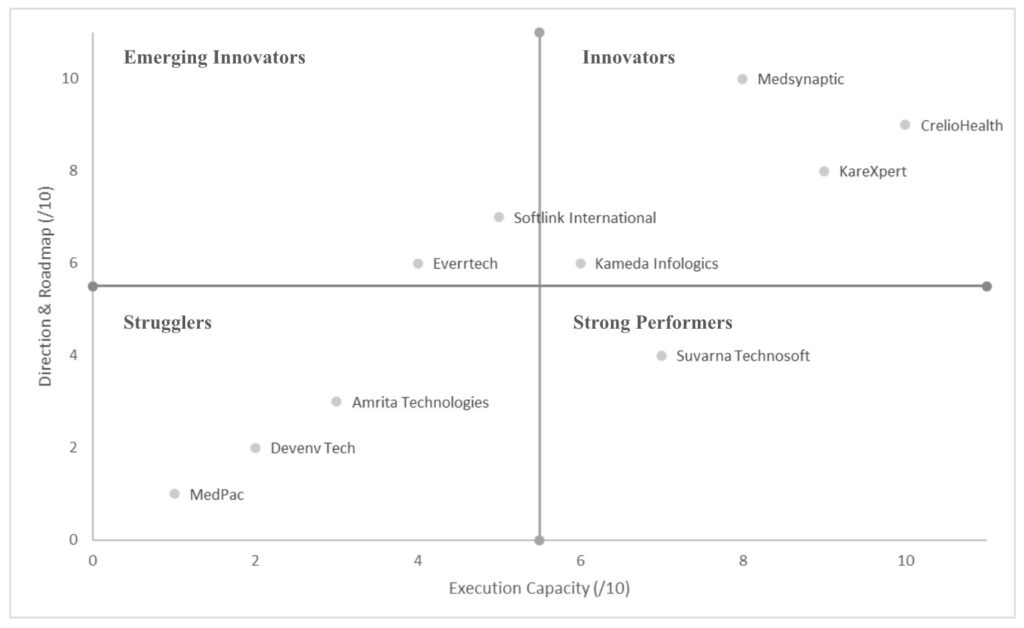
Softlink International focuses on advanced imaging tools for radiology, offering features such as MIP-MPR for multi-planar reconstructions, a fusion module for PET-CT cross-modality overlays, automated hanging protocols, and synchronized scrolling for cross-study reading. Operating in 15+ countries and self-funded, the company has 27+ years of experience and partial customizability. It complies with intermediate standards like HIPAA, DICOM, IHE, HL7, ICD-10, and CPT. However, its customer-facing team is slow to respond, with limited information from reception and frequent delays in email communication.
Kameda Infologics has a future vision strengthened by technology partnerships with FUJIFILM, Microsoft Dynamics, and EBMEDS, enabling them to deliver interoperable global healthcare solutions. Its execution capacity spans medium to large hospitals and diagnostic networks, supported by 25+ years of experience and partial customization. Kameda complies with HL7, DICOM, HIPAA-ready protocols, ICD-10, HIMSS 6/7, and Meaningful Use 1 & 2. Their pre-sales team responds promptly and handles queries efficiently.
Everrtech offers AI-assisted reporting to improve diagnostic accuracy and includes a dedicated Ortho Measurement Package for surgical planning. While globally present, the company has no external funding. It is widely adopted by mid- to large-size hospitals and diagnostic centers, backed by 10+ years of experience, full customizability, and compliance with standards such as DICOM, HL-7, and IHE. Their customer team stands out for conducting on-site pre-demo visits, ensuring personalized and well-informed guidance.
Suvarna Technosoft supports Modality Worklist (MWL) integration for smoother device communication and maintains a global presence through partnerships with IBM, Microsoft, and Oracle. With 21 years of experience, partial customization, and wide adoption across diagnostic centers and hospitals, Suvarna complies with ABDM, NABH, HIPAA, NABL, and HL7 standards.
Amrita Technologies serves a limited but premium client base, maintaining a global presence with higher-priced offerings. With 34+ years of experience and full customizability, it is widely used across mid- to large-size hospitals. It complies with standards such as US Patent, CCHIT, ARRA & Surescripts, ABDM Levels 1–3, and ISO 9001:2015.
Devenv Tech, with RIS as its core product, is in an early growth phase with around two years of market presence. It offers innovative capabilities such as an AI-powered virtual assistant, ChatGPT-5-enabled AI chat for radiologists, and TAT timers for improved reporting efficiency. The product itself shows promising maturity and stability despite the company’s young age. Devenv is fully customizable, adopted across hospitals of various sizes, and compliant with basic standards like HIPAA, DICOM 3.0, and ABDM. Their demos are well-structured and the team remains responsive.
Medpac is progressing steadily but remains in the early-to-mid stage of its product roadmap. It offers smart study routing and mobile/tablet DICOM viewing but lacks visible AI capabilities and major partnerships. With 25+ years of experience and full customizability, Medpac is adopted by small to mid-size hospitals and complies with standards such as DICOM, HL7, HIPAA, IHE, and ISO/IEC 27001.
Summary
This report provides a comparative evaluation of leading RIS/PACS vendors, examining each company’s future vision, technology capabilities, global presence, compliance maturity, and execution strength. Medsynaptic, CrelioHealth, KareXpert, Softlink International, Kameda Infologics, Everrtech, Suvarna Technosoft, Amrita Technologies, Devenv Tech, and Medpac were assessed across AI adoption, customization levels, interoperability standards, responsiveness, and customer experience. While established players offer mature, compliant, and globally deployed systems, emerging vendors bring innovation in AI, automation, and user experience. The findings help hospital decision-makers identify the best-fit provider based on technical requirements, operational readiness, and long-term scalability